The Apple “Facepalm” bug showed counterintuitivity by Apple claiming security being a big priority but taking so long to fix the problem. Mrs. Thompson submitted the issue every way she could to help but nothing worked. It took until a rival company wrote an article on the bug to finally fix Group FaceTime.
End-of-Life Care
How Mom’s Death Changed My Thinking About End-of-Life Care was an article conversing on the subject of medicare and if how much we spend is too much or too little for end of life experiences. The author wrote about how the high prices of medicare were not concerns because you care for you loved ones to give up anything for them. The problem is where the interests lie and what are the patient’s goals. Rushing into decisions won’t help because you need to do it all for the patient preferences. Sometimes going for the aggressive health treatments aren’t what’s best for the patients goals even if it means letting them pass on.
Wireless Neighbor
Won’t You Be My Wireless Neighbor? was an article about how networks were easy to share when they were without a passcode on them. The other complained they didn’t want to actually buy internet for themself but used other neighbor’s networks for free wifi. Buying the whole package was thought to them as buying all the extra stuff they didn’t want while all they wanted was access to a network they didn’t have to waste money on. Sharing a few networks would make it easier on the building.
Apple FaceTime Bug: It seems counter-intuitive that a multi-million-dollar company could not make sure its products are safe and bug free. A company that more than half of the world is familiar with. It seems counter-intuitive that people must have to take extra precautions while using something that rightfully belongs to them. A 14- year- old boy was the founder of this problem. It’s not even like he was looking to hack into his friends’ phone. Most people wouldn’t have a burning desire to hack into their friends’ phone. When he told his mother of his discovery, she immediately told Apple. However, it took them a week to respond. Why? Their biggest fear should be a hack proving their security system to be mediocre at best. What’s so surprising is that during the group FaceTime call, before the person receiving the call even answered, the caller was able to receive full audio and video access. To work on the issue, Apple, for now, shut down group FaceTime to fix the bug. What’s also counter-intuitive is the fact that they are going to be paying hackers to find other bugs. They are contradicting themselves when they say that want a better security system yet they want to reward the people who find their bugs. What will these hackers do before they report the problem? How long will it take? Apple should be able to take this into their own hands. However, they didn’t do very well making sure everything was good the first time around.
Three Parent Baby: It seems counterintuitive that two people
who want to start a family would want a third persons DNA in their child. In
the UK, they will be the first people to produce a three-parent baby. The reason
for this is to prevent genetic mutations that cause birth defects. What is done
is the eggs defective mitochondrial DNA is replaced with healthy mitochondrial DNA.
The third parent is another female donor. The genetic mutation adjustments are
only passed down through female generations. This is where it becomes kind of,
in my opinion, stupid. If say there is a birth defect, it could only be fixed in
females? What about the boys? They just have to deal with it? This DNA is not
the DNA that determines what the offspring will look like, it is the DNA that
codes how cells use energy. When a certain part of the DNA is defective it can
surely cause disease ranging from seizures to muscle weaknesses to a wide range
of diseases. The process is technically called assisted reproduction, which is
where we close to designer babies. It is to help with genetically connecting
healthy children down through generations. However, it is really made for
parents who really need help. Which is where it becomes okay. Because if you
have to worry about the well-being of your baby before it is even born, this
maybe sounds like an okay idea. What isn’t fair is that right now it seems to
only be affordable for the rich. People who need this help, they maybe might
not even be able to get the help they need because it is so out of their price
range. This wouldn’t be my got o plan because there could be so many things
that could go wrong, but I also can’t be too sure because this could be one’s
only hope to making their baby healthy.
Why Are We Happy?: It seems counterintuitive for one to say
that it is easy to find happiness. Happiness isn’t something to be found, it is
something that is synthesized. Over the course of two million years, the human
brain has tripled in mass. That does not mean that it just has tripled in size,
this means that it has gained new structures. For example, the prefrontal cortex.
This is important because it is an “experience stimulator.” We have the cognitive
power to experience things in our heads before we actually experience them in
real life. Our minds have this subconscious thing called impact bias, the
tendency to overestimate the hedonic impact of future events. Many people do in
fact that happiness is something that can be found, but no, not really.
Happiness, like said previously is something that is synthesized. Technically,
we could say in broad terms that it is the way we look at life. Anyone has the
capability of being happy. Most people think we are happy when we experience natural
happy, which is what we get when we get what we want. Others however feel as though
you can find happiness through synthetic happiness, which is what we get when
we don’t get what we want. When your ambition is bounded, we are thoughtful. When
they are unbounded, we lie, cheat and hurt others. When our fear is bounded, we
are thoughtful, and cautious. When our fears are unbounded, we are reckless and
cowardly. We cannot find happiness, we must endure, and make our own.
It seems counterintuitive that educated physicians with multiple patients of different races would be supplying a specific race with a newer antidepressant. Doctors are more likely to prescribe antidepressants to white patients with private health insurance than patients who are minorities and use Medicare or Medicaid. In 2008 only 4 percent of hispanics and black patients were prescribed medication to help with depression, yet 11 percent of white patients dealing with depression were treated with medication. It’s very odd that one group of people are prescribed a specific medication at twice the rate that two other groups of people are. These doctors go through years of schooling yet still can’t treat people equally and give them the care they deserve.
Apple Face Palm Bug
It seems counterintuitive that such a successful company like Apple would take so long to fix a bug that allows others to invade people’s privacy. A 14 year old in Arizona discovered that he could listen to people through their phones on a group FaceTime call without them even realizing it. His mother sent a video of the bug to Apple hoping that they’d fix it, but it took them more than a week to take down the group face time feature to fix it. After this story went viral, many people including myself are questioning Apple’s care about the privacy of their customers. On top of this mess, they haven’t responded to anything concerning the bug. Why it was so slow to get fixed, how the bug even surfaced, or if the 14 year old from Arizona will get compensated for his discovery.
Are Multivitamins Dangerous?
It seems counterintuitive that a group of organic compounds that are essential for normal growth and nutrition can be labeled as dangerous. Although a third of Americans take a regular dose of multivitamins, there isn’t really any evidence that points towards it making people healthier. A perfect example is the fact that Vitamin D is said to improve breast health and Vitamin B is heart healthy. A study of postmenopausal women showed multivitamins did not protect them from any of the diseases studied to be harmful.
It seems counterintuitive that apple was completely unaware of the bug that allows everyday iphone users to spy on the recipients of their calls by just the push of a button. Apple has recently discovered a bug in their technology that allows iphone users to eavesdrop, but they were not aware of the problem until days after multiple complaints were filed. Days after the bug was discovered by an ordinary teenager and his mother, apple got word of the bug and immediately decided to disable group facetime to fix the problem. Apple has rewards for discovered bugs in their technology, but how do we know that every bug can be discovered? People may be eavesdropping in multiple ways through Apple technology, and it may never be discovered because the hackers who could potentially discover these bugs may never come forward with the information, and these little bugs cannot be tracked as easily as the facetime bug.
It seems counterintuitive that you can test the stock market through an experiment of how others view women. In attempts to see what would work in the stock market, participants were shown pictures of women and then asked to report who they thought other people would think are pretty. This is because if other people are interested, then it will work out for you in the stock market world. This was then tested again with cute animals. You could say that this theory about choosing what others will like could relate to conformity, but that is in fact the basis of making money in the stock market.
It seems counterintuitive that gun control can be compared to the dangers of a swimming pool in the backyard. Statistics have shown in the past that more children die from drowning in a swimming pool than getting shot by a gun, but that cannot count for every person in the entire nation. Guns are more accessible to those with mental illness than getting a job or getting accepted into school. Much research has shown that owning a handgun in the house for “safety” will actually hurt those in the house. Owning guns in households will actually make the chances of being hurt by a gun higher. Gun control should have laws to regulate the amount of gun purchases that people can make. There should also be more thorough background checks being utilized in order to prevent those who should not be in possession of a gun from buying these dangerous weapons.
It seems counterintuitive that we buy iphones and use them knowing that there are bugs out there, in which they allow people to spy on you. We do not know how long apple has known about this but we do know they were warned and still decided to not do anything.
Personal Privacy plays a big party in everyone’s life, as well as their cell phones. The majority of cell phones are iphones and to have bugs in which people can spy on you is not acceptable. There is no way a little kid was the first to find this. Apple has known about this and they just have kept it a secret. They hire some of the best hackers in the world to work for them to find bugs. So why did they take so long to react?
Apple is one of the largest companies in the world. so some people might think theres a chance they didnt see the complaint right away or they kept it on to gain information about all of its users. After 2 weeks they finally sent a fix but this took so long because they werent done spying on the innocent people in this world. Apple is all about making profit and this move was one for them to get a better understanding on how to advertise to the world.
End Of Life Care
It seems counterintuitive that we would spend thousands of dollars to keep someone alive that has no chance of living. Medicare is used mostly during the last year of life. Most of the time the treatments are not successful and the patient dies. Having a machine pump your heart is not the ideal way of living.
It is extremely expensive and a complete waste of money to keep a loved one on a machine. Plus they probably just want to die at that point and cannot say it. It is a tough decision families have to make but they definitely have to make it. If you do spend the time and money then you will be taking care of a vegetable.
End of life care should not be a thing, people should have their lives decided by the doctors because they are professionals, not the biased family members.
Ranking Cute Animals
It seems counterintuitive to say that kittens are the cutest animal in the world. At the end of the day they are cats, and all cats are viscous and ugly. Although the poll states it, the poll does not feature puppies, and puppies are way cuter than kittens.
The dog is mans best friend, comparing a dog to a cat would draw an easy solution. But the polls show that kittens are the top voted amongst who people think is the cutest and by voting for what you think other people voted for and the kitten won. Not because it was the cutest but because it was going up against two animals that are not cute at all.
With all of that said the kitten is a very cute animal, it did receive over 4500 votes out of 12,000 people to vote on it. But it definitely is not the cutest animal in the world. There are so many animals out there it is hard to pick just one. Humans also think alike so if i am told to vote for which one would receive the most votes, i am putting myself in someone else’s body and choosing for them. Kittens may have won this vote but put a dog in there and its a different story.
It seems counterintuitive and simply unprofessional for a multinational company such as apple to simply miss and release a product with a flaw in its widely used face time that has the potential to break national security.
on January 19, a 14 year old boy made a fighting discovery while using apples group facetime, he found that he was able to spy on his friends phone without him even answering. Michele Thompson, the mother of this 14 year old boy, vigorously reached out to apple to notify of them of this problem. But it wasn’t until a week later that apple finally disabled group facetime. Apples slow reaction time to fixing a problem of this scale only increased customers concern with the company’s security efforts.
Apple a company that continuously claims of there technological safety, seems to have dropped the ball tremendously. And if an issue with the magnitude to cripple national security can slip through apple, it brings about the question, what other problems have gone undetected within apple’s products? apples inability to spot problems or bugs can lead to father exploitation by hackers, leaving the security and privacy of its customers in jeopardy.
Why keeping girls quaky clean can make them sick:
It seems counterintuitive but evidently true that Girls constant cleanliness could be the reason for higher rates of certain illnesses in women later on in life.
The theory known as the hygiene hypothesis explains the idea that younger girls are held to higher standard of cleanliness than boys, and are not exposed to the same germs and bacteria as them, leading to higher rate of illness in the future.
Women have higher rates of asthma, are more likely to have allergies, and are affected three times more by autoimmune disorders than men. This can be due to the Lack of exposure to germs by girls. Further Researchers are even suggesting the lack of exposure to parasites may be the cause for an increased rate of crohn’s disease in western nations.
The generalizations made between girls and boys can undoubtedly be related to boys increase of exposure. Girls are usually restricted to cloths not suited for outside play. Also girls are usually monitored more by parents during play decreasing the chance of them actually getting dirty.
As a matter of fact boys actually have higher rates of asthma than girls. The belief is that at their young age they are exposed to things that might inflator their immune system. So early boys have higher rates, but after puberty it is girls that have higher rates.
Why Not Regulate Guns As Seriously As Toys:
It seems counterintuitive and yet surprising that guns would be considered more dangerous in a developed and civilized country such as America.
The United States is currently flooded with guns. There are about 85 guns per 100 people in the united States, the only country topping the U.S. is Yemen a country amidst a terrorism and a growing civil war. But yet, still in America 80 people die from guns every day and several times as many as injured.
It is said that the increase purchase of guns in America is effort of being safer. As a matter of fact handgun sales in Arizona sky rocketed by 60%. But however their is and overwhelming amount of evidence that firearms actually endanger their owners. A gun in a home increases the chances of you being shot by accident, by suicide, or by homicide. And since most homicides in the home are committed by family members or friends, having a gun in the house only increases the chance of murder. Further American children are 11 times more likely to die in a gun accident than other developing countries due to the United States high prevalence of guns.
It seems counterintuitive that Apple was notified of a bug that made it so you could see through other people’s phones through FaceTime. It was not until after a week that they were notified that they acted on debug to try a make an attempt to fix it. The bug was going all far too long. The one 14 year old boy who found it could have done it many times. Imagine how many other people it happened to that said nothing!
Armored Planes
It seems counterintuitive that in World War II, many planes were shot down and destroyed. There is possibility that this could have been prevented if we had armored our planes. It is said that “Those who don’t have bullet holes make it back.” You only see that planes come back without bullet holes because the ones that do have been shot down. With armoring planes, we could save many lives as well as fight harder and stay in battle longer if it were ever necessary.
Gun Regulations:
It seems counterintuitive that this specific article goes over the good and bad of having the ability to buy your own guns. In my personal opinion I believe that guns should be legal, but you should not be allowed to buy a machine gun or any semi automatic/automatic gun. There is really no reason to have one. People who use it for self defense do not need one. People who use it for hunting do not need one. Some people will just have to suck it up that you cannot buy your own. If you really feel the need to use one then go to the shooting ranger and use one there. There is no reason to buy one.
In case I forget to ask you later, somewhere in your Notes today, please tell me what specific example in the lecture provided you with the clearest understanding of what I mean by counterintuitive, and why.
Before we begin writing a semester-worthy Research Position Paper on a counterintuitive topic, you’ll be wanting to know what I mean by counterintuitive.
I haven’t always had an outlet for my particular slant on life, but I know now it’s not particularly special or uncommon. A some point in Catholic grade school I started to wonder if maybe God was made in man’s image instead of the other way around. I know already from your “Why is there a Universe?” essays that some of you have similar suspicions.
Maybe because we can’t comprehend eternity, we call eternity God. And because we can’t comprehend infinite space without bounds, we call the limitless universe God. We can’t accept the lack of justice on earth, so we imagine heaven where the scales are all balanced. If so, God doesn’t resolve the incomprehensibility of anything; deity is just a way to think about things we can’t understand.
DISCUSS
What we believe to be the case is probably not. Call this a scientific way of thinking. Every conclusion, as soon as it’s proven, is subject to fresh dispute. That may sound like a recipe for despair, or it may sound like progress. For those of us who describe our religious views on Facebook as: “Faith in unanswerable questions,” it’s nothing special.
Speaking of Facebook, you’ve probably noticed this interesting social development:
Instead of forcing users to identify as merely male or female, Facebook first introduced a third massive category of “custom” gender options including “transgender,” “cisgender,” “gender fluid,” “intersex,” and “neither.” That satisfied users for awhile, but it’s been replaced by a drop-down menu that still lists several options:
But the search field also permits users to customize their gender identification any way they like. I’ve chosen “Who’s asking?” just to be playful, but for users uncomfortable with binary gender categories, this flexibility must be truly liberating.
I don’t know whether this will solve or further complicate a problem social media has always had of not knowing what to call us when they recommend us to others. You’ve probably noticed oddities such as, “David Hodgeswould like you to view theirpage.” Now that I’m allowed to select the pronoun I wish to be addressed by, Facebook can comfortably call me “he” and my pages “his pages.”
To be totally honest, I don’t get to choose my true preferred pronouns, which are “we” and “our” as in, “We would like you to view our page,” said the Queen, or the Editors.
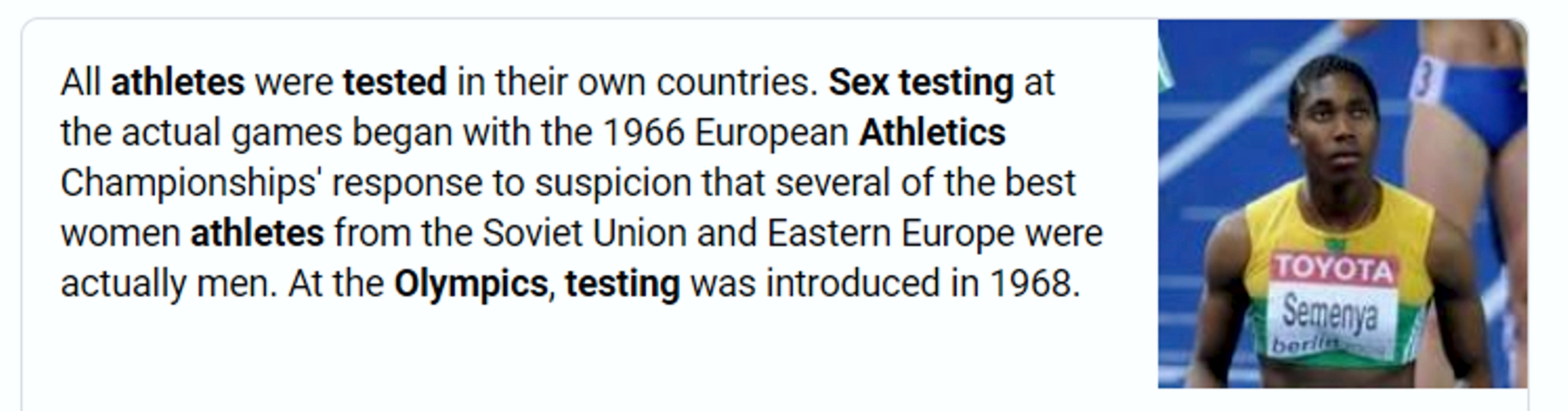
The Facebook gender evolution reminded me about Olympic athletes from ages ago whose genders created questions or disputes. Chinese gymnasts of earlier games, required by the rules to be at least 16, are thought to have been as young as 12 or 13 (girls, not women; not exactly a gender problem, but a category problem). Also loudly whispered was the question: were the 14- and 15-year-old competitors fed hormones to delay their advancing development from girlhood to womanhood so that they could still be girls when they became Olympic women?
On the other extreme, were Russian athletes in strength competitions actually genetic gentlemen competing against the ladies, or again steroid-fed women whose physiques were artificially masculine?
The Olympics stopped routine gender testing in 1999, but individuals can still be tested if their appearance causes enough dispute among rivals. Indian sprinter Dutee Chand endured hormone tests that determined the amount of testosterone her body naturally produces gave her an unfair advantage against the other women in her event.
Now finally, there are some women competing in bobsled contests, but still the gender divide is fairly complete: Men’s Downhill, and Women’s Downhill. How long can these binary categories last when in the rest of our lives we’re invited to be more selective in which gender we “present” to the world? And if gender is truly fluid, or doesn’t matter, or is disputable beyond proving, would it be better or worse to eliminate the categories altogether and open all events to all genders and ages?
DISCUSS
My Shopping List is an Argument
I will certainly tell you many times this semester that every written document is an argument. I challenge students with this premise all the time because it sounds so implausible, but I’d like to present a shopping list as an example of what I believe to be a written argument, written for a particular audience, which becomes a battleground for dispute in the hands of any other reader.
As long as I (the intended audience) have this list with me, my reader is unlikely to argue with its premises. But even so, I may decide to substitute Haagen-Dasz for Breyers if the price is right. However, if my wife takes the list to the store on my behalf, she may present compelling counterarguments to my “editorial position” on the following grounds or others:
Who needs premium ice cream?
Will he even notice the difference between conventional kale and organic kale (Is there actually a difference?)?
We already have plenty of drawstring bags.
We don’t have room for 24 more seltzer bottles.
Since when do we buy beef specifically for the dogs?
Even if the per-pill price is significantly cheaper, I can’t believe we’ll use 1000 ibuprofen before their effectiveness expires.
Diarists Lie
On this topic, please remind me to argue that a diary is written for a very specific audience and therefore is as manipulative and artificial as any other piece of writing. (If you need a preview of this demonstration I will direct you to Francine Prose’s wonderful examination of Anne Frank’s Diary of a Young Girl, titled Anne Frank The Book, The Life, the Afterlife, in which she argues convincingly that the Diary was extensively edited by Frank for the sake of future readers.)
Mitt’s Audience
On this topic also, I could share with you the video captured at Mitt Romney’s campaign fundraiser during the runup to the 2012 presidential election. If you can imagine him making the same speech to any other audience, then you haven’t started thinking seriously about how exactly we craft what we write to suit our intended readers.
Duchamp’s Readymades
Marcel Duchamp made very few pieces of art, but the few he made were enormously influential, in part because they challenged the question of what makes art art.
Here is the artist with Bicycle Wheel, a rude combination of a wheel and a stool combined in such a way that they are both deprived of their function. They no longer serve any purpose and therefore can be nothing but either art or trash.
After a pre-pandemic visit to the Philadelphia Museum of Art, where I had revisited some of his work, I found myself handling paring knives and graters in the kitchen, and asking myself the seemingly simple question: is this item art?
It’s certainly beautifully designed and crafted, but my instinct tells me its functionality prevents it from being art. My working definition is that art is something created for no other purpose than to be observed or experienced. Still, I’m disputatious, so I didn’t let that first impression stop me. It certainly didn’t stop Duchamp from calling this art:
He didn’t create it, design it, weld it, or change it in any way except to sign it and remove it from the place where it would have had a function. Placing it into an art gallery, for Duchamp, and for the rest of the art world, effectively transformed a wire bottle rack into a piece of art. So maybe my definition still works. Maybe not. Do you have a better definition for art you could pursue as a counterintuitive topic?
DISCUSS
Tim’s Vermeer
While I was puzzling over ready-mades and washing dishes, I was reminded that I hadn’t yet seen a documentary that had been on my list.
The Dutch painter Vermeer is well-known for his remarkably realistic interiors in which people and furniture are carefully arranged. He handled perspective perfectly, long before other painters had a clue how to realistically portray actual items in space.
Inventor Tim Jenison thought he might have an idea how Vermeer accomplished his remarkable achievement. He knew, as many did, that pinhole cameras had been used by artists for years to project images onto walls for reproduction.
Jenison is an inventor, not a painter, so he wondered more about how such a “machine” might help him accomplish a job than about whether the result would be art. This early question eventually led him to discover that he too could accomplish remarkably “artistic” results through mostly mechanical means. First, he built a room like the room in Vermeer’s “Music Lesson.”
Then, he dressed models in appropriate clothing.
Then, using mirrors to reflect images of the room just in front of his canvas, he mixed paints to match what he saw before him, and, without any artistic training, he produced facsimiles of the images he placed before the mirrors.
After years of practice, trial, error, and corrections, he has upset a lot of people by painting this:
One More About Art
Alexa Meade has a different way of representing three-dimensional objects as two-dimensional objects. She paints directly on the objects, turning them from objects into paintings.
This isn’t a painting of breakfast. It’s breakfast, painted.
And this is not a painting of a man on a bus. It’s a man on a bus, painted.
Here’s how it looks when she’s working on it.
Here’s how it looks when other people look at it:
Let’s apply a different way of thinking to some real-life social and ethical issues.
Bariatric Surgery
Do you have a strong feeling about bariatric surgery? I don’t. I’m sympathetic toward people who can’t seem to keep their weight under control despite their best efforts. I’ve conducted enough skirmishes with my own body to appreciate that our appetites are not merely desires we can control with “will power.”
I also don’t think “will power” is a commodity we all have access to in the same supply. So a person whose body conspires to withhold every calorie, who also lacks the psychological ability to deny himself, or the physiological signal that tells the rest of us we’re “full,” is just cursed and needs some help.
So, why does this story from the Wall Street Journal disturb me so much?
Daifailluh al-Bugami, 3 years old, is awaiting bariatric surgery. Daifailluh is among a rapidly growing number of kids in Saudi Arabia undergoing radical surgery to control their weight. In the last seven years, Daifailluh’s doctor has performed bariatric surgery on nearly 100 children under the age of 14 from countries in the Gulf region.
Euthanasia for Kids
This one takes questions of age-appropriateness to an extreme. From the New York Times: “Belgian lawmakers gave final approval on Thursday to a measure that would allow euthanasia for incurably ill children enduring insufferable pain. King Philippe is expected to sign the measure into law and make Belgium the first country to lift all age restrictions on legal, medically-induced deaths.
“Under the measure, approved 86 to 44 by the lower house, euthanasia would be permissible for terminally ill children who are close to death, experiencing ‘constant and unbearable suffering’ and can show a ‘capacity of discernment,’ meaning they can demonstrate they understand the consequences of such a choice.”
As you can imagine, despite the majority in the legislature, the prospect of letting kids decide to die, and helping them do so, has some very vehement opponents.
Why do I consider this question counterintuitive? There are more than two points of view here.
Some might object to assisted suicide period.
Others might insist we all have the right to end our lives if they’ve grown intolerable.
Those in the middle might think it’s acceptable for the very elderly to end their lives slightly prematurely but be appalled at the prospect of ending a child’s life.
All three points of view are counterintuitive.
What’s counterintuitive about them?
We can’t actively promote killing ourselves without feeling the natural resistance of our bodies to preserve themselves.
We can’t logically insist that our loved ones continue to suffer after they’ve concluded that their lives are worth more to us than to themselves and very little to either.
And if we want to claim that the elderly have a right that is somehow unavailable to youth, let me suggest this:
Distance from birth is one way to calculate age; distance from death is another.
By the second calculation, the child with the terminal illness is older than you and me.
When a Raise is a Bad Thing
Your classmate Naima works in healthcare. Yesterday she shared with me a brilliant counterintuitive insight. Eligibility for Medicaid, the government’s program that provides healthcare benefits to the poor, is determined by the applicant’s income as a percentage of the Federal Poverty Limit (FPL). Make less than a certain percentage of the limit, you qualify for benefits; make more than that percentage, and you don’t. (Notice the clever use of that semicolon!)
What that means to some of Naima’s clients is that they can’t afford to get a raise. The amount of additional money they might make would not match the amount of healthcare benefits they would lose by exceeding the poverty-limit threshold. They have to make ridiculously complicated choices. Could earning more get them out of a bad housing situation? Or help them afford healthier food? Or help them escape violence? Maybe. Probably. And wouldn’t that improve their health? Probably.
And if they were healthier, wouldn’t the loss of the healthcare benefit matter less than the improvements to their lives? Who can make that calculation? Who can afford to make that calculation?
DISCUSS
If you want to change the world . . .
change the metaphors we use to describe it.
Here is a sleeping dog:
But add just two little black dots, and here is what a predator sees when considering whether to attack the “sleeping dog.”
Now that you’ve seen the extra set of “eyes” above the dog’s eyes, you can never un-see them. Practice finding that in your arguments. Give your readers a perspective they can never un-read.
If you haven’t already done so in your Notes today, please tell me what specific example in the lecture provided you with the clearest understanding of what I mean by counterintuitive, and why.
FACT: Each card has a number on one side and a letter on the other. HYPOTHESIS: Every card that has a vowel on one side has an even number on its opposite side. THE TEST: Which card or cards must you turn over in order to test the Hypothesis?
Type your answer in the Reply field below and Save. The 15 possible answers are:
All four cards: A B C D Three cards: A B C / A B D / A C D / B C D Just two cards: A and B / A and C / A and D / B and C / B and D / C and D Just one card: Card A only / Card B only / Card C only / Card D only












![penn-teller-jenison[1]](https://rowancounterintuitive.files.wordpress.com/2016/09/penn-teller-jenison1.jpg)







 612119d
 bluntwriting88
 capched
 cardinal7218
 cfriery
 chavanillo
 Chris McGee
 christianity19
 clementine102
 comicdub
 compiistudent
 corinnebuck1219
 daphneblake25
 dayzur
 g903254
 gabythefujoshi18
 goldin92
 gooferious
 hailthegreat8
 hazelnutlatte123
 honeysucklelilac
 icedcoffeeislife
 imgoingswimming
 iwantpopsicle
 doorknob9
 BabyGoat
 jeffbezos123
 jets1313
 johnwick66
 justheretopass
 kobebryant32
 kowiklinski
 l8tersk8ter
 aquarela
 metro111c
 mrmba1
 mysterylimbo
 nina525
 nousernamefound1
 nyaj32
 oaktree1234
 pardonmyfrench13
 person345
 pomegranate4800
 Jessicariccio
 rosekyd
 rowanrat
 rowanstudent24
 runnerd4
 shadowswife
 SmilingDogTheProfWants
 sonnypetro29
 tcarter101
 thecommoncase
 wafflesrgud22
 wazoo1234
 yourfavoriteanon
 Counterintuitivity