Rebuttal Essay – Ally Hodgson

Marijuana is Bad For You, Right?

The Controlled Substances Act instated in 1970 is a piece of drug regulation legislation we still use today. This act organizes almost any prescription or illegal drug you can think of into categories. Marijuana is a schedule one drug. A schedule one drug is described as, “hav[ing] a high potential for abuse, have no currently accepted medical use in treatment in the United States, and there is a lack of accepted safety for use of the drug or other substance under medical supervision.” Schedule one drugs may not be prescribed for any medical purposes. Examples of other schedule one drugs are: heroin, lysergic acid diethylamide (LSD), peyote, and ecstasy.

Schedules 2-5 can be prescribed. Each schedule has different levels of potential for abuse. Schedule two drugs, for example morphine, have the highest potential that are still prescribed; while schedule five drugs, for example Lunesta, have the lowest. I believe marijuana should be moved to a lesser category.

Marijuana has been controversial since it was placed in the schedule one category in 1970. The Nixon administration said they did not think people could be dependent on it and therefore not a schedule one or two drug. However, since substantial research had not been done about marijuana at that time, they placed it temporarily in schedule one. Marijuana isn’t as bad as most people think.

Abovetheinfluence.org says, “in addition to the possible effects on your brain, smoking marijuana may also be hazardous to your developing lungs. Marijuana smoke contains 50% to 70% more carcinogenic hydrocarbons than tobacco smoke.” Another claim from the same site is that marijuana has more than 400 different chemicals in it. A website called stop-smoking-programs.org says, “tobacco smoke contains over 4,000 different chemicals.” Tobacco has ten times more chemicals than marijuana, yet tobacco is legal and marijuana isn’t. Marijuana cannot contain 50% to 70% more chemicals than tobacco if it has ten times less chemicals.

Also, that argument (assuming it was valid) alone is not a reason marijuana itself is bad for you, that only explains the hazards of smoking. People often clump using marijuana and smoking marijuana in the same category. MarijuanaVaporizer.com contends that “using a vaporizer avoids the burning process and, consequently, eliminates the health problems associated with smoking.”

“According to the Food and Drug Administration,” says soberrecovery.com, “there is no sound scientific studies  to carry the medical use of smoked marijuana.” On the contrary, the advocates against marijuana at drugabuse.gov do acknowledge that “scientists have confirmed that the cannabis plant contains active ingredients with therapeutic potential for relieving pain, controlling nausea, stimulating appetite, and decreasing ocular pressure.” Marijuana has at least four medicinal uses and drugabuse.gov has found scientific studies.

In Marijuana and Medicine: Assessing the Science Base, the authors state, “[since] marijuana use typically precedes rather than follows initiation of other illicit drug use, it is indeed a “gateway” drug.” However, scienceblog.com quotes a professor of pharmaceutical sciences at the University of Pittsburgh School of Pharmacy: “the gateway progression may be the most common pattern, but it’s certainly not the only order of drug use,” Ralph E. Tarter, Ph.D. says, “in fact, the reverse pattern is just as accurate for predicting who might be at risk for developing a drug dependence disorder.” Dr. Tarter was the lead scientist on a study where, again according to scienceblog.com, “[the researchers] tracked 214 boys beginning at ages 10-12, all of whom eventually used either legal or illegal drugs. When the boys reached age 22, they were categorized into three groups: those who used only alcohol or tobacco, those who started with alcohol and tobacco and then used marijuana (gateway sequence) and those who used marijuana prior to alcohol or tobacco (reverse sequence).”

Works Cited

“Chemicals in Cigarettes.” Stop Smoking Programs. 2012. 03 April, 2012.

Hodgson, Ally. “White Paper: Marijuana as a Schedule One Drug.” WordPress.com. 29 February, 2012. 03 April, 2012.

“InfoFacts: Marijuana.” National Institutes of Health National Institute on Drug Abuse The Science of Drug Abuse & Addiction. November, 2010. 03 April, 2012.

Joy, Janet E., Stanley J. Watson, Jr., and
John A. Benson, Jr. Marijuana and Medicine: Assessing the Science Base. Washington, DC: National Academy Press, 1999.

“Marijuana.” Abovetheinfluence.org. 03 April, 2012.

“Marijuana has No Medical Use according to FDA contradicts Panel.” Soberrecovery.com. 2010. 03 April, 2012.

“Marijuana Vaporizer.”  MarijuanaVaporizer.com. 1996. Web. 03 April, 2012.
Posted in x Rebuttal Essay | 3 Comments

Rebuttal Essay – Dale Hamstra

Walk the Line

Walking is something that comes naturally to all of us. It is something that we learn how to do on our own and we never forget how to walk. Walking in a straight line is just as simple, if you can see where you’re going that is. As soon someone puts on a blindfold it becomes near impossible to walk a straight line, sometimes even traveling in a circle. However, when an aural aid is provided, the person will naturally walk towards the noise in an attempt to stay straight.

During testing, everyone that participated thought that they would have no problem walking straight for a distance of fifty yards. However, they all had a surprised look when they realized that each one of them missed the target area but at least twenty feet. The average miss was by forty feet, with one person going in a complete circle. When the aural aid was added all of the participants walked toward the noise and ended up hitting the target. However, all but one took a curved path in getting there.

There are also other possible factors that may have been involved in why they did not walk in a straight line. For example, the wind blowing could have caused them to go off course. Also the ground was not as even as I originally hoped for, so imperfections in the ground could have caused some people to go off course. However, not all of my participants missed on the same side of the target, and when there was a noise for them to walk to, these factors did not seem to have the same effect.

There is also a similar experiment to the one I have been conducting at the Helsinki University of Technology. In their experiment the “test task [of the participants] was to find a sound source in a dynamic virtual acoustic environment” (Lokki, Grohn and Savioja). They were testing to see if sounds could help someone navigate through a virtual environment, and eventually find the source of the sound in the virtual world. In the results they found that “in most cases subjects did find the target area.” and that “over half the subjects made less than three errors” (Lokki, Grohn and Savioja). This provides substantial evidence that someone can walk in a straight while blindfolded, so long as there is a noise to guide them.

This shows us that it is, in fact, possible for us to walk in a straight line. This goes against the popular belief that it is impossible to walk in a straight line while blindfolded, under any circumstance. According to an article on “Science is Beautiful” “Even if the terrain is familiar but if we are blindfolded it’s really impossible for us to walk in a straight line” Popular belief tells us one of two things, either that we can easily walk in a straight line or that it is impossible. Where in reality they are both wrong.

It is not easy to walk in a straight line but it is not impossible either. Under the right circumstances someone who has a blindfold on can stay on a relatively straight path, and make it to the target area. However, it is by no means easy. People tend to think they are walking straight only to find that they have been walking in circles.

Works Cited

Lokki, Tapio, et al. A Case Study of Auditory Navigation in Virtual Acoustic Environments. 3 April 2012.

Walking in a Straight Line. 17 December 2010. 3 April 2012

Posted in x Rebuttal Essay | 3 Comments

Rebuttal Essay–Sam Sarlo

Needs a Title

One of the most seemingly logical arguments for legalization of all drugs is the examples of regulated sales and use of alcohol and tobacco. As we college students know, alcohol is easy to obtain (even for underage consumers), and socially acceptable to use, even though excessive amounts can kill. Although we know alcohol can be harmful, we feel that there is a social standard for acceptable use, and even if we don’t like it we tolerate it. Those who fear legalization argue that currently illegal drugs- heroin, for example, would become just as ingrained in our society, just as  widely acceptable, as beer and cigarettes.

In his article “In Defense of the Drug War,” John Hawkins cites some alarming statistics relating alcohol to crime. “In 2004 and 2005, 39% of all traffic-related deaths were related to alcohol consumption and 36% of convicted offenders “had been drinking alcohol when they committed their conviction offense.” 

He goes on to insist that legalized drugs would spur an explosion of substance-driven chaos and crime. Interestingly, Hawkins cites statistics that are completely opposite of what I have read elsewhere pertaining to usage rates during the prohibition and in other countries after legalization or decriminalization, but he is also a far-right conservative citing numbers from Ann Coulter’s book.

The meaning of all of these conflicting statistics begins to clear up when we examine the context of the precedents used by supporters of the drug war. I followed Hawkin’s links from some of his statistics and I came to a page on justthinktwice.com that has a compilation of stories of legalization and decriminalization gone wrong, and I noticed a trend. Most of these failed attempts did little or nothing to ensure a legal, safe supply of drugs, they merely lessened or did away with penalties for possession. Also, in the case of European nations, neighboring countries kept their prohibition laws, turning the more liberal country into a drug hub, as is the case in the Netherlands. Another example from this site which clearly demonstrates the shortcomings of decriminalization is the “Swiss Experiment,” during which drug sales and use were allowed in a certain park in Zurich. Thousands of drug users congregated in the park and the surrounding neighborhoods became riddled with crime. Taking away penalties for drug use only solves part of the drug problem because the drugs being legally used are still being illegally manufactured, smuggled, and sold by criminals. However, even some of these decriminalization policies have been shown to reduce the overall harm to a nation from drugs, such as in Portugal. Since the  nation’s total decriminalization of all drugs, drug use has dropped and so have new HIV infections, and twice as many addicts now seek treatment. The Portugese have realized that treating addicts, or at least providing them general health services such as clean needles, costs much less and has much greater possible benefit than incarceration. What we need in this country is to go beyond decriminalization and totally legalize and regulate the manufacture of drugs, saving tens of billions of taxpayer dollars per year and eliminating the dangerous underground drug culture.

As for the argument that after legalization drug use would explode, I see only circumstantial evidence. The justthinktwice.com page warns of huge increases in marijuana use where it is legally allowed or tolerated, but in reality marijuana use has been increasing everywhere, and less so in countries where it is legal or decriminalized. Another factor to consider is the honesty of the people surveyed- they’re much more likely to admit that they use drugs in a place where they will not be persecuted for it. Here in America we have some of the most restrictive drug laws in the world, yet also some of the highest rates of drug abuse, proving that prohibitive drug laws really do not stop people from doing the drugs that they want to do.

Works Cited

http://www.justthinktwice.com/factsfiction/fiction_drug_legalization_works.html

http://www.humanevents.com/article.php?id=19132

Posted in x Rebuttal Essay | 1 Comment

Revised Rebuttal Essay– Tyson Still

Sorry, But I Win

When looking at teens today that are involved with gangs, people automatically think that there is no reason they should be in it. But behind the violence and the drug dealing is a lot of pain that needs to be healed. As results are found, it shows that more teens are becoming actively involved with gangs because of their problems at home. One looking from the outside in might not realize it because  the teen does not show that he/she are hurting on the inside, but honestly they are.

Teens that are dealing with home issues often do not know how to deal with them so they seek for attention outside of their home to take their mind off of the problems they’re having. Most teens that are joining gangs today are lacking the significance of having a father figure or positive male role model in their life so the have joined a gang to feel the comfort of love and support from the male type of bonding. They often do not learn how to become a man without some type of guidance.

Even though divorce can be a great cause of why fathers are no longer around for their kids, one might argue that divorce isn’t the reason kids a joining gangs. If evidence was to be taken into consideration then it would show that about half of the world’s marriages today end in divorce but not nearly half of Americas teen population have joined gangs.

Therefore saying the results of  divorce is a factor leading kids in to a gang related lifestyle is wrong. I totally disagree with that rebuttal if it was to be made because most divorce leads fathers or even mothers away from the family which is what causes the seeking of love by a father or even mother. No one is saying that divorce is the leading cause of teens joining gangs, but it does make a good argument to say that it might play a big role in it.

Another argument that could come about is why aren’t all kids or teens in gangs that do not have a father in their life? Even if they don’t have that positive male role model in their life as stated in the previous essay, why are they doing good in life without one?

My answer to that would be that not all teens take a divorce between their parents hard some might take it as a relief as if the father was abusive to the mother or even to them. Some children might not even have been born with a father around to get that attachment where they would need it in the future because they have had the chance  to experience it already. No one is the same so some people take to situations different than others.

Some children have they luxury of having a mother that know how to cope with the their child not having a father figure, that’s why when the child is being brought up they might not need the guidance of a male figure in their life because the mother is playing the role of the all around parent. If the child is small enough and the mother has another boyfriend or man in her life and he takes on the positive role of becoming the father figure then the child will not be in need of its biological father because the comfort and love is still being fulfilled.

Teens on the other hand might have a different view on this concept. What happens when they meet the new father figure that is suppose to be a positve male role model, but still isn’t used to having him around and they either want their own father back or want their mother to themselves? What if the “new father” is in the teens life but they aren’t making an attempt to fulfill the needs of the teen? One might continue to say that it is easier to mold a little child into accepting the fact that he or she has a new father in their life. After a couple of months they get used to him and start to forget about the divorce or break up. But for a teens who might have grown up with their father for  some odd years might not be able to adapt to that life style of beginning into a different family aspect.

I say yes it is easier to mold a little child into accepting a new father figure that has a positive insight on that childs life, but also it is easier for a teen to understand what happened and why it happened and then once they accept the fact that what did happen happened, they will begin to come around and realize life goes on. Now with that being said just because he or she accepts the fact of what did happen, they might then take that initial step and say well I don’t want to have a new father with my mother or as stated before the “new father” might not be playing that specific role correctly which can also lead to gang related people into the teens life as he or she starts to adapt to living in that type of environment.

There are benefits of not having a father around though. The most popular one is that you have a chance to be better than your father was. Teens might say that their father did this and didn’t do that but according to Brett and Kate “you don’t need your father to be your father figure” meaning you can find that father in someone else that is successful at being a great father.

I agree with that statement but that still doesn’t defeat the fact that most teens today that are being influenced by music and other people that live a life of crime, needs the father figure to be there for them. That’s why it is being proven that not having a father is leading kids to gangs because they don’t have no on to look up to so they follow the wrong people into the wrong life to live.

My main oint is that many arguments can be made to prove there are other reasons teens get led into the gang life, but if statistics are researched and shown my theory that not having a positive male role model leads kids into gangs as well can be proven.

Works Cited

Not having a father Kate Fogarty and Garret D. Evans Web.  April 3, 2012

Benefit of not having a father  Brett & Kate McKay on June 17, 2009

Posted in x Rebuttal Essay | 2 Comments

Rebuttal Essay – Jon Otero

Don’t Judge a Book by its Cover

While many Americans today affected by obesity are being anchored down by their heavy weight physically and mentally, there are those who would argue that this condition is not at all a disease. Opponents of obesity sometimes develop the wrong idea that obesity is actually a lifestyle choice.  So when these people hear about a drug that could fight obesity, currently under trial by the FDA, they don’t particularly care for it because they feel like these people could just choose to stop being obese. This is a flaw in logic that must be addressed before I can convince people that Qnexa should be passed. It stems from another problem: misinformation. Although obesity is not actually classified as a disease, it is far from merely being a lifestyle choice and has been proven to be full of dangers that cannot simply be given up due to many physical and financial restrictions placed on so many obese people.

First of all, obesity cannot simply be generalized as a lifestyle choice. To say that would be ignoring all of the factors that are tied into a person’s weight. Evidence suggests that genetics, wealth, environments, and even the health of mothers during pregnancy can shape a person’s body. Just because an obese person eats does not mean that person is choosing to remain obese. Obesity can start even before birth. When a mother is overweight or obese during her pregnancy, she risks developing gestational diabetes. This gestational diabetes can cause the child to be born with a high birth weight. Children born with high birth weight become susceptible to childhood obesity, the precursor to its adult form. Even before pregnancy, certain genes can cause people to inherit thyroid deficiencies. The thyroid is a gland responsible for metabolizing of energy. When it doesn’t function properly, energy will not be used and will be stored as fat. Just like a person can inherit genes, they also inherit wealth to varying degrees. Healthy food is expensive and cheap food often lacks nutrition. When a person cannot gather the essential nutrients to carry out bodily functions, because of their environment or economical status, the body stores fat. Even psychological factors or habits unrelated to food or exercise can cause a person to gain weight. With that said, obesity is far from being a lifestyle choice for so many Americans.

A person arguing that drugs shouldn’t be passed for obesity since it isn’t a disease is relying on incomplete information. Without enough information on the subject, a person can warp any argument in their favor if they are speaking to a non-skeptical crowd. Firstly, the FDA has passed a plethora of drugs targeting many “non-diseases” classified as medical conditions or disorders. The fact that obesity is a medical condition according to the CDC should not be taken as an excuse to disregard its prevalence and dangers. It also has ties to many diseases and other conditions that unfortunately cannot always be treated by a drug and are usually irreversible. Such diseases like coronary heart disease, type 2 diabetes, high blood pressure, stroke, and osteoarthritis are just some of many complications that a person becomes susceptible to as they continue their lives as obese. Passing Qnexa can help stray these people away from the dangers they’re headed toward.

Some opponents of anti-obesity campaigns argue that most people don’t even die from obesity. Even if a person doesn’t view obesity specifically as a disease, it’s tied to enough medical complications, diseases, and conditions to cause it to be a big concern for the Center of Disease Control (CDC). Its Division of Nutrition, Physical Activity, and Obesity (DNPAO) is attempting to address the issue by combating some of the factors that contribute to nation’s current epidemic. If the situation were left alone, many Americans would die. While obesity doesn’t always directly cause a person to die, most of the time an obese person dies due to a disease or condition they developed because they were obese. “Individuals who are obese have a significantly increased risk of death from all causes, compared with healthy weight individuals.” (WIN) Even though obesity cannot technically be deemed as the cause of death, it indirectly takes the lives of the people it has affected in one form or another.

Most arguments against the danger of obesity fail to realize that the condition is not as simple as eating too much and looking big. The reason why obesity has become the condition it is in the United States is due to many economical, environmental, and genetic factors. Without proper education on the various stressors that are affecting those plagued by obesity, progress toward the solution will not be any easier. Safe measures should be adopted to help the situation, like the adoption of DNPAO programs and approval of safe drugs like Qnexa. These measures can help lower the mortality rates associated with obesity.

Works Cited

Gestational Diabetes.” Centers for Disease Control and Prevention. Centers for Disease Control and Prevention, 21 Oct. 2011. Web. 03 Apr. 2012.

Overweight and Obesity Statistics.” WIN. Web. 03 Apr. 2012.

Posted in x Rebuttal Essay | 2 Comments

Rebuttal Essay – Jesse Samaritano

The Twisted Morals of Music Piracy

Despite the common knowledge that taking something without paying for it is stealing, there has been a worldwide debate throughout the last decade on whether music piracy through file sharing is an acceptable practice or a crime that should be punishable. The debate has split opinions from everyday people who want to justify their actions or call others criminals. Even the artists, famous and not, are split on the subject. Regardless to the debates going on in our country and the world, file sharing of pirated music is illegal, so it should not be done by anyone.


Many arguments are made by people who are for file sharing of pirated music is that it is not stealing, but only sharing them. These people say that there is no difference between sharing a CD with a friend down the road to burn it onto his or her computer and sharing the same CD with the entire Internet to download. To that, I say no, it is not. There are a large number of differences between these two examples. To start off though, both examples are illegal, so people should not do either. People cannot legally reproduce anything that is someone else’s media production without paying them per song or per cd price for the rights. Another reason why there is a difference is when someone gives a friend a CD to burn onto his or her computer, you know the reason why the person wants the CD. They may just want to hear a new band that the person who is lending the CD told him or her about, and that helps bands make new fans. When people distribute pirated music on the Internet through file sharing, they are making it available for anyone who wants it. Instead of the petty crime of lending music to a friend, file sharing pirated music allows an endless amount of people to steal music, taking the crime to a much larger scale.
Musicians have a hard time making money through album sales, but the people who are for file sharing of pirated music still say that musicians don’t get paid “that much” through record sales anyway, or that the artists don’t lose that much profit through music piracy. Although this may be true, it does not justify letting hundreds of thousands of people steal the artists music because it DOES take away some of the artist revenue, even if it is “not that much.” The record industry in the past decade has been on a steady decline. The combined impact of the Internet, the record companies’ slow response, the availability of single tracks instead of albums, more access to music listening online and unlicensed copying have put a 50% dent in music sales. When an album is made, the record companies pay for the band to make the album. They pay for the recording studio time, production, distribution after the albums completion, and many more cost that go into making an album. The Record companies pay the artist in advance to make the album, but majority of their pay comes from royalties through album sale. Royalties are what the artists get paid as a percentage of each album sold. The percentage is not a large percent (usually around 13% of each album sold), but during the time recording companies pay for the making of the album, they charge the band an advance against royalties. The record company may pay the band a set amount of money during the album’s development in order to have the members of a band have a source of income ahead of time so they can pay for their own living standard. That advance will be recouped before any royalties are paid. So when someone posts music illegally on the Internet, they are showing no regard for the artists’ hard work. So to refute those who use the excuse that artists don’t make that much from record sales, I will not say that they are wrong necessarily, but saying this does not justify ripping off the artists’ of their deserved pay.

Along with this argument that musicians don’t make a lot of their profits from album sales, people who support music piracy also say that the record labels make too much money that artists should be making off record sales. This is just another excuse to steal from an entire industry. Record labels help artists’ names get out into the world, and into our wallets. Without the record labels, a lot of great bands, maybe even some of your favorite bands, would still be no names or only famous in the underground scene of their genre of music. The only recordings they would have would be garage quality recordings, unless they were wealthy enough to pay for their own recording time in a studio and produce their own music, which would be unheard of with so many starving artists. Every band or artist starts out small, and with a record company who discovers them will start out with a low royalty deal. But the artists that do make it onto the Billboard Top 100 don’t complain about record companies because they know that the record companies helped them get where they are today. With the loss of revenues to the record companies through illegal downloading of music on the Internet, record labels will not be able to sign as many bands as they did in the past. This will harm up and coming artists because they may never have a chance to be signed to the companies as easily as in the past.


Any arguments that are for music piracy and illegal downloads via file sharing are only excuses by people to justify their own bad behavior through twisting their own morals. This is a crime that a large percent of the population is guilty of. The real problem lies in peoples beliefs toward the subject, and peoples’ attitudes on this subject reflects on other aspects in their lives. Anyone at some point in their life has tried to justify doing something they know is wrong. If someone tells a lie to a friend, they usually think, “Hey, I know I’m lying, but it’s probably better that they don’t know the truth.” In some cases, this may be right, but the bottom line is that we know when we are doing something wrong, and making excuses will never make it right.

References

Clifton, Sam. “How Much the Musicians Get from Album Sales” 2010. Web. 02 Apr. 2012.

Cumberland, Rob. “Record Companies and Labels” Bemuso.com. 2002-2012. Web. 02 Apr. 2012.

Brain, Marshal. “How Recording Contracts Work” 22 May 2003.  HowStuffWorks.com. Web. 02 April 2012.

Recording Industry Association of America (RIAA)”  RIAA, 2012. Web. 02 Apr. 2012.

Posted in x Rebuttal Essay | 1 Comment

Rebuttal Essay- Brett Lang

Supporting the killer?

Someone looking at a substance that is a large risk factor and killer and thinking there shouldn’t be some change in the product, or the way it is handled is ridiculous. Ephedra put many people’s lives at risk and even ended some as well. Regulation and construction of the product has to be addressed. Some people may feel that there is no reason to waste time and money on supplement regulation, but the risk of losing one’s life seems to be a very important thing to consider when dealing with anything, let alone a dietary supplement.

The main point in the argument against improving regulation of the dietary supplements will be that the better regulation, safety precautions, and change in rules will not stop all dangerous supplements from being put on sale. That is true and I agree highly with that. There are plenty of drugs out there that have slipped through FDA regulation and been put on sale, but turned out to be very dangerous to people’s health. For example the drug Darvocet was recently banned by the FDA for causing bad heart side effects (Darvocet). Drugs just like this happen to sneak by the regulations, but the regulations have also stopped tons of terrible drugs from being put out on the shelves to be sold too. Just because better regulations won’t stop all of the terrible supplements from being sold on the market doesn’t mean they shouldn’t be fixed and tightened up. It’s like saying well people still rob banks, so lets stop having laws against it and security precautions to stop it. The security and laws clearly stop the acts from happening more frequently and lessen the number of robberies. If you tighten the regulations up on the supplements, and make the safety testing be done before and after sale, the chances that harmful supplements will be on the market will clearly become fewer in number.

The tight regulations and safety precautions would help the supplement manufactures find more issues with their product, and could cause them to be less deceitful in their claims, and ingredient information. If there are more regulations that ask for proof of safety testing before being sold, then it would create a more honest producer. If the manufacturers can’t get their product out on sale until it is proven safe with clear evidence, then they are more likely to make sure of the safety in their product, and create a better product for the user and a more honest supplier in the manufacturers. As of now they can sell a product as long as they say it does what they say their product does. They don’t have to worry about what happens to the user later because they could sell millions of their supplement before testing shows its risks, but when they must have proof of safety before sale this changes things completely. If the manufacturers are losing out on making money they will make sure their product is on the up and up with regulations. Everything changes when people’s wallets are threatened.

The combination of caffeine with the Ephedra is what causes such excessive dangers to occur to the user, not just the stimulant. This is a very misconstrued thought by some people believing the problem is not the plant being used, but the other combination of ingredients inside the product. These kind of people will feel like Metabolife 356 is dangerous because of the mixture in the caffeine, but the use of just the Ephedra in itself is safe for them. The combination of the caffeine may make the supplement more dangerous, but the key point in that is it will make it “more” dangerous. The Ephedra has been tested and proved to be a high stimulant that causes the heart to race quickly. It affects the central nervous system along with causing the heart to race because of the very lethal stimulants in Ephedra (What is Ephedrine?). The combination may cause a more severe effect on the user, but the mixture is not the start of the problem. The Ephedra is just a high amphetamine like stimulant that alone causes the damage to the body and heart, and is increased when the caffeine is added.

The main basis of the disagreement with the change of the regulations and dangers of such Ephedra based supplements as Metabolife 356 is quite weak. The regulatory system becoming tightly ran would create a more careful examination of supplements, and a safer way of controlling dangerous substances to be sold. It also creates a more honest and loyal manufacturer that must now follow the rules before selling his product, which hurts his profit, making him more likely to make sure his product is safe, so it will be allowed to be sold. The combination of caffeine and Ephedra does create a very dangerous concoction and increases the risk to the supplement causing damage to the heart, but it does not create this problem. That is made up in the Ephedra itself with its high stimulant ingredients that just alone has been proven dangerous to someone. The tighter regulations and safety precautions that could be set up for dietary supplements may not stop all the dangerous substances that try to get sold, but as long as it catches at least one, isn’t that better than letting them be unregulated safely to prey upon uninformed users looking for a little weight loss?

Works Cited

Darvocet 

What is Ephedrine?

Posted in x Rebuttal Essay | 2 Comments

Rebuttal Essay- Eddie Jahn

Sabermetrics vs. Experience

When looking at modern-day baseball there is a lot of talk about sabermetrics and how baseball is a game of numbers. There are formulas that calculate wins and losses. The statisticians can keep crunching numbers, but for the results of the game it is all based on the players. The players have to hit the ninety-seven miles per hour baseball when there are runners on second and third base and the team is counting on them to get a hit and drive the runs in. A statistician cannot calculate how a player will react at that moment it is all on the player and the decision that he makes and also on the outcome of the play. Baseball is a game that is eighty percent mental and twenty percent physical.

The hardest part about hitting a baseball is described by all-star center fielder Tori Hunter  in usatoday.com as “a matter of precision, adjustment and accuracy, and there’s not much room for error. Miss by a half-inch, and you can top the ball or hit it into the ground. You have to have hand-eye coordination to adjust to the ball’s speed, and you have to see the rotation of the ball.” The fact of the matter is that a batter cannot so much as blink during a baseball pitch because if he does then the batter will miss the release point, the rotation of the ball, or the ball will just be past the strike zone leaving the batter no time to react to the pitch. There cannot be statistics for a person’s ability to hit a baseball, or to get out because it is up to the batter or pitcher to make a play either strike the batter out or have the batter get a hit. Statistics can also not account for the ground balls that get through the infield between two defensive players or the bloop fly ball that  dunks in for a base hit just inside the foul line. Baseball is a game based on experience, reactions, and having a strong mind that can handle the pressure of a situation.

A team that wants to win a championship has to be smart, they have to think about what kind of players they need on the team. This can be done during free agency, during the Major League Baseball draft, or during the offseason. Teams should first look into free agency because that is where players who have proven themselves in the major leagues before are in because their contract has expired and are looking for a new contract. Free agency is a key part in baseball, big name players are taken in free agency every year. Some examples include Jose Reyes who was an all-star for the New York Mets, he was one of their franchise players, but when his contract was up last year the Mets let him go into free agency and the Miami Marlins now have him on their team. Reyes is a threat to steal at any time provides amazing speed and his defensive abilities at short stop are outstanding. He is a pickup in free agency that will greatly impact both the Mets and Marlins.  One other notable free agent pickup was Albert Pujols. He went from the world champion St. Louis Cardinals to the Los Angeles Angels of  Anaheim. This acquisition was amazing for the Angels, Pujols on his career has 445 home runs and a career batting average of  .328 according to MLB.com. With either of those players on a team it will bring success and the ability to build around those players with other stars or draft picks.

A team like the New York Yankees have won 27 World Series, they do it by signing great players that have proved themselves in the major leagues or they draft prospects into their farm system where they can prove themselves worthy of coming up and competing at the major league level. They have had so much success because they have the highest payroll in baseball. They go out during free agency and sign big name players that will help their team win championships. Some examples of players they have brought in within the last couple years have been C.C. Sabathia who has proved himself in the majors for years with the Cleveland Indians and Milwaukee Brewers, he was an all-star  with the Indians in 2004 and 2007 as examined by MLB.com. The Yankees brought him into their organization because they needed pitching and he was the best pitcher available so they went out and signed him, and they won a championship within the year they signed him in 2009. The Yankees also brought in Curtis Granderson who is a center fielder and he played for the Detroit Tigers prior to coming to the Yankees. Granderson had a breakout year in 2011 finishing second in homeruns with 41 also he was an all-star, he won the Silver Slugger Award, and the MLB Choice American League Outstanding  Player Award (MLB.com). Those were two offseason free agent acquisitions that paid off huge for the Yankees and they went by those two players’ major league experience and their great career statistics.

A baseball player’s mind can be his worst enemy or best friend. Statistics do not account for cold streaks and hot streaks of players. Players go through stretches where they will hit anything and everything that a pitcher will throw at them, and also they go through stretches where they would not be able to hit a beach ball if thrown to them. This is where the mind of a player comes into play, when on a cold streak the player’s mind will not be confident and will not believe they are able to hit the ball, and they will not. When on a hot streak the player will not even be thinking about if he can hit the ball he will be thinking where do I want to drive this ball? Statistics cannot show those two characteristics of players, it can show how he hit the ball in the regular season which may not be great, but if he were to go on a hot streak into the playoffs and help the team win a championship his regular season numbers would still not be great. One other thing statistics cannot show is the amount of heart in a player. A player can have a batting average that is not great, but every time out on the field he hustles every time a ball is near him, runs out ever ground ball in case he may beat it out for a hit, this is not shown with statistics.   Baseball may be a game of numbers, but it is also a game of experience, heart, determination, mental focus, and the ability to fight through adversity.


Works Cited

“Albert Pujols Stats.” MLB.com. Web. 30 Mar. 2012.

Mihoces, Gary. “The Hardest: Getting Bat to Meet Ball.” USA Today. Gannett, 2008. Web. 30 Mar. 2012.

“MLB Player Batting Stats- 2011.” ESPN.com. Web. 30 Mar. 2012.

Posted in x Rebuttal Essay | 4 Comments

Facts, Inferences, Judgments

Coins with Two Heads

Claims are debatable assertions. They are the heart of argument. Your thesis statement is always a claim of one kind or another. Without claims, there are no essays worthy of calling essays. You write a clear and vivid thesis statement (your claim) precisely to call your reader’s attention to the assertion you wish to debate. You plan to win the debate, of course, by providing evidence to support your claim, and reasoning to draw the appropriate inferences from that support and, in some cases, to recommend action that should be taken because of the claim you have proved.

Factual Claims are your evidence; your interpretations of the evidence are Inferential Claims, you base your recommendations for action on Judgment Claims.

CLAIMS OF FACT
Ordinarily, we don’t debate claims of fact, but we can refute them on the basis of accuracy.

  • A coin is as likely to turn up heads as tails.
  • Over time, a single coin will turn up heads as often as it turns up tails.

INFERENTIAL CLAIMS
Inferential claims might sound like facts, but they’re actually opinions based on facts or conclusions drawn from an analysis of facts. Every inferential claim can be argued, because every inferential claim is in fact an argument and, what’s more, it may contain countless smaller steps that can also be argued.

  • After ten heads in a row, tails is more likely on the next flip.
  • Every flip after the first is influenced by prior flips.
  • After the first flip, no flip is fifty-fifty.

JUDGMENT CLAIMS
Judgment claims are opinions based on values, beliefs or philosophical concepts. They expand inferences into prescriptive statements about what should or should not happen, once we accept that the inferences are true.

  • No coin toss after the first should ever be used to determine questions of consequence.

Notice how the ground has changed under this argument as it progressed from facts to judgments. The fact that a coin is as likely to show heads as tails is challenged by a reasonable inference that once it has flipped heads ten times in a row, it’s almost certain to flip tails next, to an equally reasonable inference that if ten flips influence the next flip, each flip must influence the next one-tenth as much, to a conclusion that flips after the first are not wholly random, followed by the judgment that if not wholly random, coin flips shouldn’t be used to produce the sort of randomness we consider fair.

Mathematicians tell us that even after ten head flips, a coin is still just as likely to turn up heads as tails, and we may be able to rationally agree, but we don’t listen to arguments wholly rationally, and it sure seems more likely we’ll see a tail next.

Inferences, therefore, are the dangerous part of argument.

The video below makes a straightforward argument in favor of harvesting the organs of death row inmates following their execution for transplantation into patients who will die without new organs. (It’s a little grisly, but if you can watch Saw or Dexter, you’ll be fine.) Listen for the facts, the inferences, and the judgments.

Next up comes a story from the Wall Street Journal that reports China will soon stop harvesting organs from its executed prisoners. This is not an opinion argument, but watch out for inferences and judgments anyway. Here’s the entire text:

China to Stop Harvesting Inmate Organs

By LAURIE BURKITT

BEIJING—China officials plan to phase out organ harvesting of death-row inmates, a move to overhaul a transplant system that has for years relied on prisoners and organ traffickers to serve those in need of transplants.

Huang Jiefu, China’s vice minister of health, said on Thursday that Chinese officials plan to abolish the practice within the next five years and to create a national organ-donation system, according to a report from the state-run Xinhua news agency.

“The pledge to abolish organ donations from condemned prisoners represents the resolve of the government,” Xinhua quoted Mr. Huang as saying. The Ministry of Health didn’t respond to requests to comment.

Officials in the world’s most populous country have conceded that China has depended for years on executed prisoners as its main source of organ supply for ailing citizens. Human-rights groups say the harvesting is often forced and influences the pace of China’s executions. Mr. Huang has been quoted in state media reports as saying that the rights of death-row prisoners have been fully respected and that the state asks for written consent prior to donation.

Due in part to traditional beliefs and distrust of the medical system, voluntary donations are rare in China, where the need for organs far exceeds the supply. An estimated 1.5 million people in China are in need of organ transplants annually, while only 10,000 receive them, according to government statistics. In the U.S. in 2009, 14,632 organs were donated, while the transplant wait list had 104,898 patients, according to data from the Organ Procurement and Transplantation Network and the Scientific Registry of Transplant Recipients.

An estimated 65% of China’s organ donations come from prisoners, according to 2009 data, the most recent available, from human-rights advocacy organization Amnesty International.

Chinese officials have said relying on organs from prisoners isn’t ideal. Human-rights advocates doubt that China will be able to phase out the system entirely, because of the heavy dependence on it. They say that the government’s efforts to educate the public on organ donation have been inadequate. “Officials repeatedly make announcements every few years, but they don’t appear to have a solid plan in place,” said Sarah Schafer, a Hong Kong-based China researcher for Amnesty International.

The dependence on prisoners for their organs influences the timing of executions in China and in many cases bars inmates from the ability to appeal their death sentences, she said. While such appeals are rare in China, prisoners sometimes get a reprieve on death sentences, enabling them to escape execution.

Xinhua cited Mr. Huang as saying that infection rates for prisoners’ organs are typically high, causing a lower long-term survival rate for Chinese with transplanted organs than for people in other countries.

China’s previous efforts to stem the practice have faltered, Ms. Schafer said, citing a goal set five years ago by Chinese officials to reduce reliance on prisoner organs by 2012. Xinhua reported that the number of organ donations from inmates has decreased in recent years due to a more prudent use of the death penalty, though it didn’t supply specifics.

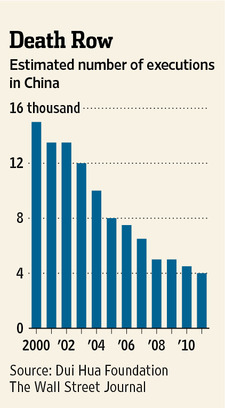
China doesn’t publicly report execution figures, but San Francisco-based human-rights group Dui Hua Foundation estimates that 4,000 prisoners were executed in 2011. China’s death penalty rates are higher than any other country in the world, according to Dui Hua figures. Amnesty International no longer reports execution data from China, but believes the figure is “in the thousands.”

By comparison, there were 43 executions in the U.S. in 2011, according to Washington nonprofit organization Death Penalty Information Center.

Some Chinese patients awaiting transplants say abolishing inmate donations will be akin to a death sentence for them, according to a report published in the medical journal Lancet in 2011. The report said the number of patients requiring transplants is growing due to the rise in chronic and noncommunicable diseases in China.

The Ministry of Health and the Red Cross launched a voluntary organ donation program beginning in 2010 that has been tried out in 16 of China’s mainland cities and provinces. Since March 2010 the program has resulted in the donation of 546 major organs, according to a statement from the Red Cross.

China’s lack of available organs has also created a black market for ailing patients wealthy enough to afford them. State-owned China Daily has reported that kidneys purchased from organ traffickers can cost about $29,000.

Chinese officials banned organ trafficking in 2007, restricting all living organ donations to spouses, blood relatives, and people with close family ties.

—Yang Jie contributed to this article.

Presumed Consent

Although the word compulsory is usually used in arguments of this sort, the more accurate term in most jurisdictions is “presumed consent.” In countries where organ donation is automatic upon death, people are given an opportunity to “opt out” of the obligation by registering their refusal to donate organs, just as in this country we register our willingness to donate ours. The burden shifts to those who oppose donation, but it’s not much of a burden to make their wishes officially known.

Should Donation be Compulsory?

Now let’s hear from a young man whose life was saved by a double lung transplant. Surely he’s in favor of donation.

http://www.4thought.tv/themes/should-organ-donation-be-made-compulsory/oli-lewington?autoplay=true

Don’t Give Your Heart Away

And finally, here’s a very thorough explanation of the mechanics of “non-paired” organ donation (the donations which, like the heart, are not part of a pair of organs) from an ardent opponent of donation who recommends carrying an “opt-out” card to avoid the possibility of becoming a donor.

Posted in Critical Reading SP19, David Hodges, Professor Posts | Leave a comment

Rebuttal Essay (First Draft) — Jon Gonzoph

Virtual Violence: Negative effects are not only unproven, but also roughly on par with playing a real game of football.

Due to the wide variety of contradicting sources and great controversy in the news media, it is conceivable for one who studies the effects of video game violence to come to the conclusion that it causes aggression. While it would be simple to write a rebuttal to this view using sources that do not support this theory, it would also be near pointless to do so – anyone who has any real support behind their belief would simply introduce a study to counter any of the conclusions I draw. Instead, I will proceed upon the hypothesis that video games do cause aggression, and defend against the common following argument that video games are causing definite harm. This also limits me to only the sources that do not directly refute that video games cause aggression. Despite this handicap, it is still evident that many of those studies suffer from a number of faults. There is little consensus on how long the increased aggression last, and if it will build up over time. These studies do not take into account at least one quite meaningful variable. Finally, there is nothing to explain why this increased aggression is more from video games is more of a danger than increased aggression from other media and activities.

The first important discrepancy between studies supporting violence in video games is their lack of agreement on the timeframe this aggression lasts. Many studies subscribe to the General Aggression Model (GAM), which states that in video game play that increases aggression in the short term will carry over and increase aggression on a longer timeframe. Some studies that use this interpretation this are the “Longer You Play” study by Christopher P. Barlett and the study of video game violence on German adolescents conducted by Muller and Krahe, though the former at least admits that more study is needed to conclusively prove this effect (Muller) (Barlett). Conveniently, Barlett and others followed this line of questioning and published a study titled “How long do the short-term violent video game effects last?” He tests for aggressive thoughts and feelings after playing a violent video game using the standard proven questionnaires, but also employs the hot sauce paradigm at either zero, five, or ten minutes after violent game play has ceased. The hot sauce paradigm is a test of aggressive behavior where a participant is informed that he is responsible for preparing a cup of hot chili sauce for another participant who does not like spicy foods; the level of aggression is measured by the type and amount of sauce given. After 10 minutes the measured levels of aggression spike sharply downward, indicating that the effects of video games only last this amount of time (Harris). While this does not completely disprove the GAM model, it casts doubt on studies with results that depend upon it, which greatly weakens support for the position that violence in video games causes significant effects.

Another point of contention that weakens these studies is that they do not control for all important variables. One of the most glaring examples of this is shown by Paul Adachi and Teena Willoughby, who conducted a two part study to test the effects of violence in a video game versus the effects of competitiveness, difficult, and pace of action.  The first part of the study found that both the violent action game and the nonviolent racing one produced an equal increase in aggression. The second study concluded that between four games, 2 violent and 2 nonviolent, the violent and nonviolent game that were judged to be more competitive showed a much greater increase in aggression than the two less competitive ones (Adachi). Though it may only be one variable, this is of paramount importance. If it is not violence in video games but rather competition that causes adverse effects, then any study that does not take this into account cannot give fully reliable conclusions.

A particularly determined individual may not be swayed by the above arguments. Regardless of the issues with the studies which find violence in video games produces a significant level of increased aggression, this individual may simply assume that more research could solve the problem. However, even if violence in video games is conclusively linked to an increase in aggression, one major problem still remains – a multitude of other things are also believed to increase aggression. Violence in television broadcasts has been linked to increase aggression for years, with many studies, such as one by Paul Haridakis, taking this for granted and instead trying to determine what causes the difference in aggression changes by examining the motivations and backgrounds of the participants (Haridakis). Playing sports has also been linked to increase aggression, as a study published in the Ovidius University Annals showed that 300 secondary school students who were involved in sports generally tested higher on aggression scales than 300 who were not (Arslan). One study even compared the level of aggression between those playing violent video games and those who ascribe to a traditional masculine ideology and found that both correlate with a higher level of aggression (Thomas). This means that just being exposed to the traditional gender roles has the chance to increase aggression, something that is nearly unavoidable. Despite this similarity in effect, many see sports and males conforming to traditional gender roles as healthy for children while simultaneously deriding television and video games for corrupting youth. And while it is certain that sports and television do produce a benefit, not much research has been done on what benefit video games produce. Without this additional research it is difficult to judge video games in relation the great number of other media and activities that also appear to cause increased aggression.

Clearly, even by only using sources that support an increase in aggression through video game use, the argument that video games cause significant harm is not very strong. There are few studies that prove to any extent that this aggression last longer than a very short time after play. Significant variables, such as the difficulty and competition inspired by the game, have not been taking into consideration when designing a majority of these studies. Further, there are a multitude of things that cause an increase in aggression, from sports to gender roles, and little evidence that increased aggression from video games causes any greater damage.

Works Cited

  1. Adachi, Paul J. C., and Teena Willoughby. “The Effect Of Video Game Competition And Violence On Aggressive Behavior: Which Characteristic Has The Greatest Influence?.” Psychology Of Violence 1.4 (2011): 259-274. PsycARTICLES. Web. 2 Apr. 2012.
  2. Arslan Fatma, et al. “The Study Of Aggression Level Of Secondary Students Who Play Sports And Do Not Play Sports.” Ovidius University Annals, Series Physical Education & Sport/Science, Movement & Health 9.2 (2009): 202-205. SPORTDiscus with Full Text. Web. 3 Apr. 2012.
  3. Barlett, Christopher P., Richard J. Harris, and Ross Baldassaro. “Longer You Play, The More Hostile You Feel: Examination Of First Person Shooter Video Games And Aggression During Video Game Play.” Aggressive Behavior 33.6 (2007): 486-497. Academic Search Premier. Web. 3 Apr. 2012
  4. Haridakis, Paul M. “Men, Women, And Televised Violence: Predicting Viewer Aggression In Male And Female Television Viewers.” Communication Quarterly 54.2 (2006): 227-255. Academic Search Premier. Web. 3 Apr. 2012.
  5. Harris, Richard, et al. “How Long Do The Short-Term Violent Video Game Effects Last?.” Aggressive Behavior 35.3 (2009): 225-236. Academic Search Premier. Web. 3 Apr. 2012.
  6.  Möller, Ingrid, and Barbara Krahé. “Exposure To Violent Video Games And Aggression In German Adolescents: A Longitudinal Analysis.” Aggressive Behavior 35.1 (2009): 75-89. Academic Search Premier. Web. 7 Mar. 2012.
  7. Thomas, Kimberly D., and Ronald F. Levant. “Does The Endorsement Of Traditional Masculinity Ideology Moderate The Relationship Between Exposure To Violent Video Games And Aggression?.” Journal Of Men’s Studies 20.1 (2012): 47-56. SPORTDiscus with Full Text. Web. 3 Apr. 2012.
Posted in x Rebuttal Essay | 2 Comments