For the second time this semester I’m calling out the work of your classmate Cardinal as a model to emulate.
You may recall me recommending Cardinal’s “Stone Money” assignment as among the best I’ve ever read, if not the very best. Now I’ve found his/her White Paper to be equally deserving of praise.
If you’re unclear how a White Paper functions, spend a few minutes reading Cardinal’s. You’ll see that beyond merely describing the content of the sources, Cardinal has begun earnestly to compose the first drafts of his/her position paper arguments. This practice of drafting new language while reviewing sources is precisely how White Papers are supposed to work. When they’re good, they provide most of the language you’ll need to produce your arguments as they are assigned.
The effects of maternal parenting style and religious commitment on self-regulation, academic achievement, and risk behavior among African-American parochial college students
This article goes into depth between religiosity, both parent and student, and maternal parenting style. They did a study with around 85 students, and they were required to complete a self-assessment that calculates self-regulation, risk behavior, and religiosity. When they were done conducting their experiment, they found authoritative parenting kids have a higher level of school performance and analyzing skills. They were also able to find out that committed religious students have a higher chance of doing well academically.
Influence of parenting styles on adolescent delinquency in delta central senatorial district
The “Delta central senatorial district” conducted an investigation on young students; they looked into gender, age, etc. and found out that the parents are positive in their teaching habits and are more social, interact with more people their age work towards goals. In comparison, parents exercise their authority to control children’s adolescents’ behavior.
Authoritarian parenting: What happens to the kids?
Gwen Dewar, Ph.D., wrote an article on an authoritarian parenting style and was able to find out that if a parent is less warm and reactive with their child, it can affect the child’s health, and it’s worse if the child was to grow up in the difficult environment. His studies suggest “warmth can protect kids from the effects of toxic stress.” Some people think with demanding authoritarian parents, their child is better in school, but that’s wrong based on the evidence Gwen Dewar, Ph.D., found out, “Permissive Parents are emotionally warm, but reluctant to enforce rules or standards of conduct,” Uninvolved Parents are like permissive parents, but they lack warmth,” and “Authoritative Parents set limits and enforce standards. But unlike authoritarian parents, authoritative parents are very responsive or nurturing”.
Parenting in Relation to School Dropout Through Student Engagement: A Longitudinal Study
In this article, we find out what changes can happen in a child’s life with different parents. They stated that “adolescents (age 14) with more authoritative parents (high acceptance, supervision, and psychological autonomy granting) were more likely to have graduated at age 22 compared to adolescents with less authoritative parents”. This experiment proves that you have a good relationship with your child is essential; it could improve your child’s will to go to school and help reduce the chances of your child dropping out of school.
The Peer Group as a Context: Moderating Effects on Relations Between Maternal Parenting and Social and School Adjustment in Chinese Children
In this Article, they study Chinese children around 11 years old. It was between “maternal supportive parenting and social and school adjustment.” After they conducted their experiment and looked through all the details, they found out “group prosocial‐cooperative functioning strengthened the role of supportive parenting in helping children develop social and school competence,” The experiment proved that social groups mature in Chinese kids.
Authoritarian parenting style, Tracy Trautner
In this article Tracy Traunter tells her facts about what Authoritarian parents do.
This is not what I thought a definition essay due to the fact that it doesn’t have any explanation for what gay marriage and how it seen in the eye of the law. while it does cover several different topics related to gay marriage. However does not offer any over all while it is in support of gay marriage it does not actually address anything. i believe that it needs to be more concise and have more hard valad points to make a stronger argument.
With Viewership and Revenue Booming, Esports Set to Compete with Traditional Sports
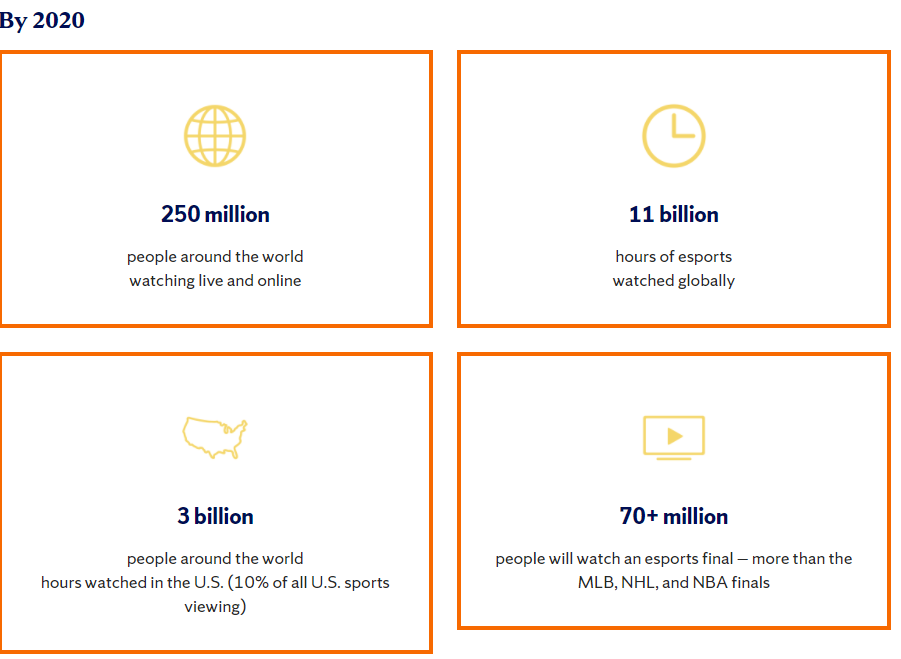
They use the comparison of Ninja (Tyler Blevins) to the likes of Tom Brady and Lebron James. According to Syracuse University, “Technology consulting firm Activate estimates more than 250 million people watch esports,” and along with that most of them play those games as well. Syracuse also states, “By 2020, Activate suggest that 70 million people will watch a single esports final, which is higher than the viewership for U.S. professional baseball, soccer, and hockey finals.” Also by 2020, as a collective, we will have watched, “3 billion hours of esports.” Also, because esports isn’t, “rooted in any region or culture,” there is a broader reach globally for popularity.
Twitch, owned by Amazon, is the worlds biggest live streaming platform. According to Ali Moiz, the CEO of Streamlabs, Twitch is the first of its kind; it has the ability to create real-time reactions between the streamer and audience. Ali Moiz also states that it is, “exciting for people to donate to their favorite Twitch streamer and hear them call you out live on stream in front of thousands of people.”
Over time the esports industry has been taking pages out of the sports industries playbook. Overwatch, for example, has created their own Overwatch League. Also, according to ESPN, “Disney signed a deal with Blizzard to bring the league to ESPN and ABC.” Esports has also grabbed the attention of the Olympic games. Another example of esports as a, “competitive threat,” to traditional sports is NBA 2K. The NBA recently created their own esports league as well.
Another historic moment for esports, and the gaming industry as a whole was when Ninja played with Drake live on stream (I was there for it). Blevins’ peaked in viewership with Twitchs’ all time viewer record, 635,000. There is also growth within the collegiate esport community.
According to Syracuse University in terms of esports marketability it will be quite similar to hose of traditional esports and the steaming services, such as Twitch, will greatly, “assist marketers in creating optimized advertising.” Syracuse also stated, “data analytics and artificial intelligence may change how esports games are played.” They further this point with a very interesting comparison of Elon Musk’s OpenAI to professional esports players. This sheds light on the possibility of players vs. computers in competition.
Due to tough guy mentality, many players will attempt to shrug off their injuries and continue to play regardless of the consequences after. According to Harvard University, “repeated blows to the head, not just those that are severe enough to cause concussions, increase the risk for a variety of symptoms later in life, such as depression, poor motivation and concentration, and problems with learning and memory.” When someone withstands a concussion it accelerate quickly, and then decelerates as it hits against the skull. Nerve cells get stretched, and their connection get disrupted and torn.
More recently there’s been a major focus on repeated impacts, which occur quite often in football. CTE, neurodegeneration, and “second-impact syndrome”. According to Harvard the are most worried about back-to-back impacts which can cause death due to brain swelling.
“NFL leaders have not been quick to endorse the idea that employment as a player is a risk factor for chronic brain disease,” Harvard states. Football, as a sport, is inherently violent. The players enjoy the game while they play, but then may have to suffer the consequences later on in life long after retirement.
NFL commissioner Roger Goodell has stated that the powerful influence of the NFL could be used to enforce brain health protocols/protections to protect their players and our youth.
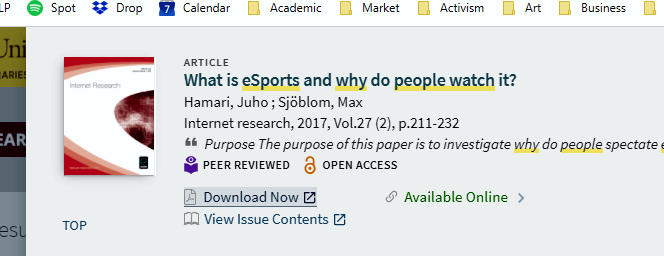
Professor Note: To gain access to the PDF you “don’t know how to open,” search for the article by title in the Rowan Library database while you’re logged into your Rowan account. As a tuition-paying member of the academic community, you should be able to open most journal documents.
—DSH
Turns out this is simple. Click Download Now. The button:
The result:
PDF in Files – Esports Athletes and Players: A Comparative Study
(Definition/Classification Argument) Explain How a Term or Category is Understood or Misunderstood, Used or Misused, how Related things differ, or how Unrelated things are similar
Esports aren’t real sports. By definition, esports are different than real sports, but there is no distinction besides the physical exertion, and public opinion.
(Cause/Effect Argument) Explore a Causal Relationship Essential to your research
Injuries in Traditional Sports to the growing popularity of esports.
(Rebuttal Argument) Reveal a Counterargument to be flawed
Traditional sports will never but fully removed from our culture, yet sensitivity of our population could lead us in that direction.
4. Current State of the Research Paper
Describe in a brief paragraph how you’re feeling so far about the progress you’ve made, how your opinions have changed (or solidified), and what you anticipate will be your eventual outcome.
I believe this is exactly what I’m looking for. My hypothesis is quite radical from what most are saying. The general belief is that the esports industry will continue to grow over the years, but there is little evidence to suggest that traditional sports will be eliminated anytime soon. However, my argument, states that virtual reality sporting will provide a safer alternative. For example, the concussion epidemic in the NFL could get itself banned. Quite Black Mirror-esque but still possible to argue I believe. Definitely need more evidence to support it though.
In Stravinsky’s “Rite of Spring,” the piccolo makes a surprise appearance.
Most students are using things like facebook and other methods of contacting each to work with each other. Parents are concerned that they may have to prequartine their children before sending them to college. Many of the colleges are requiring a physical before the student comes on campus. Parent’s also have to be cautious when going to visit their children. This new circumstance will require us to find a new way of forming social connections. Like using group messages and other things like that to interact with each other
News sources from CNN say that college experience may never be the same again. The pandemic has threatened to upend both private and public models. Many universities are considering to postpone in person classe until 2021 I believe that this may be postponed until at least 2023 not because of restrictions but because of many people will too paranoid to go to in person classes until we receive a vaccine that 100% effective which will most likely not happen for a decent amount of time. This is an issue because many students face to face interactions and learn better from that. This has forced students from all over the country to adjust to these changes. This could mean financial disaster for these colleges and the small business impacted by it.
Will the Coronavirus Forever Alter the College Experience?
A professor at loyola university gave his first virtual lecture from his courtyard in a bathrobe drinking a glass of wine. Lafayette college has trained their facutility to make document cameras for remote letcheres. Even Hamilton college has set up wifi hotspots for students to attend virtual lectures. Colleges have even made use of Tik Tok for their music students to work with a safe remote and creative environment.
How the coronavirus pandemic has changed college admissions
There is a large amount of uncertainty in how things have changed how long things will stay like this. The unfortunate answer is that no one knows. The simple fact is that for the foreseeable future in this year alon 19 states have closed all public schoo.ls which can be very damaging especially to those who really need a formal education and without it they will have a very hard time with things once things go back to normal. We have also seen a stall in standardized testing such as the SAT,ACT over one million high juniors have missed their chance to take their first SAT and this delay can drastically hurt the amount of the student coming into college.even the seniors of this are `being robbed of the true experience of college and having their freshman year experiences. Such as meeting their peers and making lifelong friends and making bonds that can only be established in person.
Many students are stressed in what should be the best time of their lives. With the pandemic anxiety level has risen high. Some highschools have gone pass fail with their grades and all sports have been suspended which is also an issue for students whom rely on sports to go to college to begin with. Resulting in a large amount of people having the opportunity to go to get a higher education. Which does nothing but hurts the future of the U.S. economy because with the proper education we can not grow and develop as a country.
If Colleges Can’t Welcome Students to Campus in the Fall, Some Might Close for Good
Many of the smaller colleges face closure if they are not able to welcome students in the coming fall unlike the bigger division 1 schools. Many smaller colleges don’t have a large amount of money received from alumni. This is a very sad and unfortunate circumstance meaning people who do not meet the requirements of a big 10 school will have a harder time getting a college education or go to a community college. There is also the problem of these colleges being too expensive for a lot of people to afford.
The phenomenon surrounding K-pop culture in the United States is largely impart to their cultural appropriation in black culture.
Purposeful Summaries:
K-Pop Has a Cultural Appropriation Problem
It seems counterintuitive that K-pop idols relish in the benefits of black hip hop culture, yet do not understand the significance of it. With these artists choosing to imitate the genre’s concept in clothing and music, it should be expected that they are educated in the origins of this music. Unfortunately, these idols emulate the hip hop concept because they view it as a popular trend that they can follow for either their own satisfaction or the audience’s appeal. They continue to turn a blind eye towards the damage that they are causing towards the hip hop genre and how they are disrespecting black hip hop artists.
[Weekender] Dress down to be hip, hop on fashion stage
It seems counterintuitive that the Korean fashion industry is reaping the benefits of hip hop inspired fashion lines, yet there is no social responsibility or context as to how hip hop clothing was developed to combat social inequities. South Koreans prioritize appearances, especially the various clothing styles people wear. They would take any piece of clothing and try to make it into an unique fashion statement. It is no surprise that their fashion industry has adapted to the hip hop clothing style. Local clothing stores are capitalizing on these styles and selling them at more affordable prices for the youth.
‘They use our culture’: The Black creatives and fans holding K-pop accountable
It seems counterintuitive that Korean music industry moguls are actively soliciting to collaborate in hip hop influenced Korean music, yet do not compensate inadequately to artists who represent the genre. There are numerous successful songs in K-pop that have been written and produced by Black Americans. However, despite K-pop being heavily reliant on hip hop and black culture, they give little to no support towards black lives. Korean music companies would look for inspiration from the west and take anything that can be useful in appealing to the audience. Coincidentally, they took interest in black culture and attempted to take anything from it without giving them the credit that they deserve.
Performing Post-Racial Asianness: K-Pop’s Appropriation of Hip-Hop Culture: Congress on Research in Dance Conference Proceedings
It seems counterintuitive that K-pop is utilizing all popular parts of hip hop culture and music, yet do not understand the implications of racism and oppress black artists have been through. American hip-hop has been portrayed with exaggeration, and stereotypes of Black Americans such as gangstas and rowdy behavior. In addition, their body movements and clothing accessories are exaggerated to portray a hardcore gangster look. K-pop artists managed to adapt and modify this portrayal of American hip-hop culture to be more toned down for their own style in K-pop.
There would be no K-pop without cultural appropriation. Is that bad?
It seems counterintuitive that K-pop culture and music has continued to benefit economically without providing the appropriation to the hip hop genre’s culture and history. South Korea has been notorious for taking things from what they have observed and adapting it into their own style. In fact, various artists in the industry have been lucky enough in getting away with appropriating black hip hop culture, yet can have detrimental outcomes. Despite artists such as BTS and CL being greatly favored internationally, their tendencies of appropriating black culture and/or remixing the hip hop genre can lead to tension with other hip hop artists. Consequencently, this can lead to economic, social, and political ramifications.
I decided to take the advice involving my hypothesis into consideration, but I am still a bit doubtful about it. I feel like my sources are a bit redundant, but they do have some specific details that give me a good idea on where to look next.
1.Emotional abuse, which is also known as psychological or verbal abuse, is a very common childhood problem, and usually occurs in the family environment by children’s parents.
2.Making a child feel worthless, unloved, alone or scared is emotional abuse, which is also known as psychological or verbal abuse, and parents unconsciously harm their children by emotionally abusing them.
3.Making a child feel worthless, unloved, alone or scared is emotional abuse, and when parents unconsciously harm their children by emotionally abusing them, it affects neurological development of children.
4.Making a child feel worthless, unloved, alone or scared is emotional abuse, and when parents unconsciously harm their children by emotionally abusing them; it affects neurological development of children, therefore children may display life-long cognitive problems, which usually are noticed by day-care centers and schools.
5.Making a child feel worthless, unloved, alone or scared is emotional abuse; when parents unconsciously harm their children by emotionally abusing them, especially in early years of life, it affects neurological development of children. Therefore, children may display life-long cognitive problems, which usually are noticed by day-care centers, schools and health workers.
6.Making a child feel worthless, unloved, alone or scared is emotional abuse; when parents unconsciously harm their children by emotionally abusing them, especially in early years of life, it affects neurological development of children. Therefore, children may display life-long cognitive problems, which usually are noticed by day-care centers, schools and health workers.
Working hypothesis: Emotional abuse is a common form of parent abusing, and its psychological damage is as severe as physical damage. Parents, too often, unconsciously harm their children by emotionally abusing them, especially in early years of life. It affects neurological development of children. Therefore, children may display life-long cognitive problems, which usually are noticed by day-care centers, schools and health workers.
This article shows us a clear relationship between physical, emotional, and sexual abuse and neglect during childhood and negative impacts in children’s neurological development. Contrary to what many parents think, emotional abuse is very common and it has the highest harm standard compared to other forms of abuse(Sedlak & Broadhurst, 1996). Yet, it’s difficult to recognize and prove it in a legal manner. Even though most children are emotionally abused by someone, it usually occurs when people unconsciously approach a child, which means that is not necessarily intentional but still harms. This emotional neglect causes problems in development functions across the board.
In this study, forty-two adolescents without psychiatric diagnoses were tested. It elaborates different forms of abuse. According to the results, traumatic childhood experiences -including emotional abuse- change brain structures negatively. The researchers found out that dorsolateral, orbitofrontal, and subgenual prefrontal cortices, striatum, amygdala, hippocampus, and cerebellum were influenced and these influences were associated with emotional neglect.
This study’s objective was to highlight the negative effects of emotional abuse in childhood. However, the datas showed that compared to physically abused children, neglected children have more severe cognitive and academic deficits, social withdrawal and limited peer interactions, and internalizing (as opposed to externalizing) problems. Emotionally neglected children’s performance was considered low compared to other children who were emotionally stable. The researchers also found that neglected children were more likely to be angry and inpatient.
This article claims that all forms of abuse should be considered risky as they impact maltreated children’s life constantly.
Current State of Research Paper: it’s easy to find resources for my hypothesis and so far I enjoyed working on it. Yet, researches related to my topic are mostly realized with adults. As child emotional abuse and its consequences are a new matter compared to other themes in psychology such as depression and the neurological damage usually shows up in following years, I couldn’t define an age range. I’m trying to find more resources that would allow me to focus on children from 0-6 years of age.
Actor John Boyega recently made headlines with a spontaneous, vulnerable speech at a Black Lives Matter protest in London. Now, he is also speaking out about his experience as a black man in Star Wars. In 2015, he was marketed and written as a lead character for the first film in the new Star Wars trilogy. However, in the next film, his character was turned into a sideplot, and a white character took his leading spot in the narrative. The third film couldn’t quite give back to him what had been lost. In addition to that, Boyega was sent death threats from hateful fans upon his casting reveal because of his race. People even tried to boycott that first movie because he was in it. As if that weren’t enough, when press tours came around, stylists didn’t want him to dress too ethnically and didn’t know how to style his hair.
Perhaps Boyega is expected to smile and say that working on Star Wars was an amazing experience and opportunity, but he is not one to be silenced. These days, he is taking on projects that inspire him, challenge him, and embrace Blackness. He doesn’t stand aside when he sees something is wrong, and there is certainly something wrong in Hollywood. He experienced it firsthand.
Definition
How can TV and movies get representation right? We asked 6 Hollywood diversity consultants.
Six diversity consultants sat down with Vox to discuss what good diversity is. What it really comes down to is characters that are not only diverse but that also have meaning and personal weight in the story. A character may be black, but do they have their own character arc and have narrative significance separate from a white character? Is that character’s experience written authentically and respectfully, or does it play into stereotypes? Will a white audience gain understanding about another person’s experience and sympathize with it? These are questions that need to be asked when tackling diversity in a story. The people working behind the camera are a huge part of the issue. A white writer or director can talk to a person of color when developing a story in order to write a more accurate non-white character, but there is a significant difference between a white creator respectfully writing a black character and a black creator writing a black character. A writer who writes from experience can add natural authenticity to a story on a level unmatched by someone who doesn’t share that experience, so what really needs to happen is getting more writers and directors of color behind the camera.
The Reckoning Over Representation: Black Hollywood Speaks Out, But Is the Industry Listening?
Black actors have been historically mistreated in Hollywood. They are viewed as “disposable” when their white counterparts are not. White people they work with can horribly mistreat them and face no consequences. Black actors are made to feel that they don’t matter because the industry makes no move to care about them.
The industry clearly needs to change, and black voices are finally speaking out about their experiences and frustrations about how Hollywood is structured to favor white people and hold back opportunities from people of color.
For example, black people often get blocked from telling their own stories. I film or biopic centered on a black person might get pitched, which is all well and good, but a white writer or director will get signed on to make it, whether it’s for the recognizability of their name or their resume. Such a practice locks creators of color out of the room. Someone can’t become a recognizable name if they aren’t given the chance to work on big projects. Someone can’t have a resume full of impressive credits if they’re not given opportunities. Hollywood wants famous, distinguished storytellers behind projects, but the famous storytellers are mostly white because for most of Hollywood history, white people were the only ones given opportunities. It’s a vicious cycle.
While there are inclusion initiatives, they often don’t make real change. Television diversity programs are a prime example. Such programs serve as a way for writers and directors of color to get their foot in the door. Once they get that first job, though, it’s hard for them to progress. Once they’re no longer in the program, opportunities for promotion wear thin. Also, networks or studios typically pay the creators in a diversity program, not the showrunner. Thus, showrunners are thus prompted to keep these creators in low-level positions so the network will continue to pay them and then replace the creators once they’re no longer in a program with creators who are in a program so their salary won’t come out of the show’s budget. Even programs specifically designed to make a more diverse Hollywood fall flat when facing a structure that is racist to the core.
Diverse Characters Increasing On-Screen, but Viewers Want Better Portrayals
A Horowitz Research report revealed that many people of color and white people alike felt offended by the way people of color were portrayed in media. However, premium channels and streaming services have the edge- over half of the people of color surveyed for the report said that premium or streaming content had the best portrayals of people of color.
I just wanted this for the statistics revealed in that report, but I couldn’t gain direct access to the report.
Cause/Effect
TV watching and online streaming surge during lockdown
According to data collected by the UK’s Office of Communications, streaming services surged during COVID lockdowns. Netflix gained 10 million new subscribers between March and May. Over half of the UK’s new streaming subscribers said they’d keep their subscriptions even after lockdown measures let up. People seem to be realizing the convenience and quality of streaming services because of the pandemic, and if that attitude grows it could lead to streaming overtaking Hollywood.
Audiences Want Diversity In Hollywood. Hollywood’s Been Slow To Get The Message.
A long held belief in Hollywood is that diversity doesn’t sell. However, that is simply not true. Some movies, like Black Panther, have garnered success on a scale that permeates the public consciousness. It could be temping to write off such success as the exception rather than the rule, but diverse films perform better in general than less diverse films.
#OscarsSoWhite: how Stuart Hall explains why nothing changes in Hollywood and everything is changing.
Molina-Guzmán, I. (2016). OscarsSoWhite: how Stuart Hall explains why nothing changes in Hollywood and everything is changing. Critical Studies in Media Communication, 33(5), 438–454. https://doi.org/10.1080/15295036.2016.1227864
Minorities have been historically underrepresented both on screen, behind the camera, and in executive positions in Hollywood, and an interesting question to consider is why theatrical Hollywood makes such slow progress in diversity. The situation becomes even more interesting when considering the fact that diversity is increasing in television while change is minimal in the movies.
Movies and television reflect the real world, so looking at the stories and structures of Hollywood helps one to recognize problems and perceptions in society as a whole. When looking at old movies and noticing the blatant racism, it’s easy to write the movies off as a product of their time. However, old movies defined the archetypes of the movie industry, and thus those archetypes are still being used today, if less blatantly racist. Sometimes. That’s one reason why Hollywood changes at such a slow pace.
As the U.S. population shifts to having a larger percentage of minority citizens, the demand for diversity in entertainment also increases. In addition, minorities watch movies at a higher rate than their white counterparts.
Journalism also contributes to Hollywood’s slow diversity progress. When diversity does seem to be increasing- whether it be the success of a non-white producer or a multicultural cast of a tv show- the news praises even minimal visible diversity up-and-down and highlights the individual success of creators and actors. In doing so, the struggle and prejudice minorities in the industry face are pushed under the rug.
Minority actors are less likely to be represented by major talent agencies and therefore are less likely to be considered for major roles. When they are featured in a show or movie, the role they play is often portrayed as threatening or exotic.
The entertainment industry has a real shot at becoming more meaningfully diverse now that new ways to distribute media are becoming popular. The content on streaming services isn’t restricted and regulated the way content is in conventional Hollywood. Therefore, original content on streaming services has the ability to push boundaries that conventional Hollywood won’t approach. Streaming services also pay close attention to the wants of their audience statistically, and tailor their content to match those wants. Without the constraints of the Hollywood structure, stories that are not only diverse but complex and authentic are told.
House of Netflix: Streaming Media and Digital Lore
The emergence of the streaming industry challenges the long-held practices of Hollywood. As services like Netflix gain cultural impact, things like cable subscriptions lose their appeal. Younger people are leaning towards relying on streaming. With a streaming service, a person can access content from the past or present, at any time he wants, on several different devices, and also get recommendations on what to watch based on an algorithm. That on-demand capability is more appealing to many than, say, network television.
A theory in Hollywood is that of “industry lore.” Basically, that means knowing or deciding what kinds of media are possible and what kinds of media will sell. Often, “industry lore” means unspoken knowledge of what the industry’s upper echelon wants and catering to that. However, with the introduction of streaming shaking the industry up in a major way, “industry lore” has to adapt. Cable companies are falling behind because they didn’t believe in the potential of streaming services and didn’t invest when they had the chance.
Look at Netflix, which has become a cultural staple. When its original content first began winning Emmy awards, that was an indicator that the entertainment industry was changing. A shift toward streaming was beginning. Television could gain awards and critical acclaim even if it didn’t air on television. As streaming services create original content that is deemed to be of good quality by critics and general audiences, they grow more legitimate in the eyes of the industry and the general public. The ability to release a season of television all at once also changes how the industry works. Giving the viewer the ability to watch a long succession of episodes in a short amount of time allows him to better pick up on connections in the plot, thus leaving him feeling like the show is complex and of higher quality. The absence of ads on a service like Netflix is also a point for streaming. Production companies don’t have to answer to advertisers and the audience’s viewing experience doesn’t get interrupted.
With the use of algorithms, streaming services can tailor the viewer’s experience to the viewer himself, showing him content that he will likely want to see. Meanwhile, networks can only air so many shows on their lineup, which they air for millions of people at the same time, hoping that something will stick.
Audiences are also growing tired of cable companies. Many are “cutting the cord,” or cutting off their cable subscriptions and switching completely to streaming. If this trend continues, cable could become obsolete.
Race, Gender, Hollywood: Representation in Cultural Production and Digital Media’s Potential for Change
Erigha, M. (2015). Race, Gender, Hollywood: Representation in Cultural Production and Digital Media’s Potential for Change. Sociology Compass, 9(1), 78–89. https://doi.org/10.1111/soc4.12237
Hollywood has played an integral role in shaping popular culture and the minds of the general public, but the most prominent of Hollywood’s stories are told by white men in an overwhelming majority. Non-white creators are underrepresented even today, despite a push from activists and general audiences for more diversity. However, with a shift toward digital media and streaming changing the industry, the future might be a little brighter than the present.
The values depicted in movies and TV shows are the values of the people creating them. Because of Hollywood’s impact, those values- again, the values of mostly white men- become a part of society’s collective psyche. When minorities aren’t given the prominence that white men are given in entertainment, they are silenced, and their experiences and values don’t get to shape our culture the way that those of whites do.
Numerical representation is a part of the battle. Currently, minorities in entertainment are represented at a lower percentage than their share of the U.S population. Raising the numbers is a part of the battle, but the quantity is arguably meaningless if the quality of representation is sub-par. Granted, quality is subjective. Generally, characters of color who are multi-faceted and have fully realized arcs separate from a white counterpart are accepted as “good representation” in addition to creators of color getting opportunities to tell stories across a plethora of genres with as much creative control as possible. Another facet of diversity is about minorities having access to the core of Hollywood production. Currently, minorities struggle to gain access to positions of power at major studios or get signed to major talent agencies in comparison to their white counterparts.
Minorities are not only underrepresented numerically in Hollywood, but the productions that are created by minorities are often critically ignored in favor of those created by whites. For example, a Black-directed film did not win Best Picture at the Academy Awards until 2013, with Steve McQueen’s 12 Years a Slave.
Numbers are still important though, and the numbers aren’t too promising. Consider Hollywood’s 2011-2012 season. Out of a sample of 1,061 TV shows, 73% of cable shows had minorities directing 10% or less of the episodes. Only 15% of lead roles were played by actors of color, despite racial minorities occupying 36% of the population. Theatrically, out of the 172 top-grossing films, only 10% of lead roles were played by actors of color. Writers of color are also historically underrepresented both on TV and theatrically. Writers of color made up only 9-10% of television writers and 5-6% of screenwriters from 2005-2009. If creators of color were better represented, then that would likely affect the representation seen in casting and writing as well, but alas, there is still a long way to go.
Minority actors and creators are often associated with roles or projects that perpetuate stereotypes. Actors of color often play roles that are built on stereotypes of their race, for example Asian characters that excel in martial arts. Creators are often offered work that have racialized topics. For example, Black directors and writers were overrepresented in movies about the music industry.
Portraying minorities in negative ways and perpetuating stereotypes impacts public opinion about the group being portrayed and build biases against a given group.
The growing popularity of streaming platforms could open the way for more diversity. Media does not have to appeal to a general audience- it can target a specific group of people when it’s going to be offered on a streaming platform where the audience controls its experience. Since streaming is new, minorities can take advantage of the opportunity. Hollywood has a system and a hierarchy that has been in place for decades and will be hard to change. Streaming is too new to be bogged down by that, so minorities can get their foot in the door. Positive reception to well-executed diversity in streamed media will tell Hollywood that diversity sells, and could thus push Hollywood to change its ways. Also, younger generations are more likely to want diversity in their media and are also more likely to interact with digital media, so streaming services that want to be on the cutting edge of what their audience wants will cater to the desire of more diversity.
Streaming is transforming Hollywood’s outdated ideas about inclusion, says TIFF panel
Jeremy Kay. (2020). Streaming is transforming Hollywood’s outdated ideas about inclusion, says TIFF panel. Screen International.
Streaming services are challenging the long-held entertainment industry belief that minorities don’t sell, according to Stephanie Allain, the producer of Netflix’s Dear White People. One of her movies, featuring a black female lead and streamed on Netflix, found success in Brazil. The movie likely wouldn’t have gotten the backing to be produced theatrically, and therefore wouldn’t have been seen by a Brazilian audience. Netflix gives creators of color and stories about characters of color the chance to not only be made but reach audiences around the world, offering many more opportunities for success.
One negative thing about streaming services like Netflix is that there is so much content to choose from that there is no guarantee a certain movie or tv show will reach a wide audience. Still, though, the doors streaming has opened for diversity cannot be denied.
What often happens if a movie is unsuccessful is people point to the minorities in it as the reason. If a movie flops and a woman was the lead, it is said that the female lead was the reason it flopped, when in reality there are many reasons for a movie to not land unrelated to gender or race. Then, when a movie is successful and has a diverse cast, it is often considered an isolated incident.
However, the cry for diversity is getting louder, and diverse voices in entertainment are currently in demand.
Rebuttal
Hollywood Diversity Report 2020: A Tale of Two Hollywoods
This study covers 286 theatrical releases in 2018 and 2019, and it proves that diverse films perform well worldwide. Films with 21-51% minority casts performed the best overseas. Even on the extreme ends, diverse films performed better. Films with over 50% minority casts did better overseas than films with less than 11% minority casts. It’s a bit confusing that Hollywood studios still struggle to embrace diversity given these facts, but a look at the people in power make the picture clearer. The overwhelming majority of studio executives and CEOs are white.
Looking into this data proves that films featuring people of color performed better than similar films with less minority actors in the main casts. First, look at 2018’s superhero flick Black Panther, which featured a predominantly Black cast and ended up being the 12th highest grossing film of all time. It outperformed other 2018 franchise blockbusters such as Aquaman and Jurassic World: Fallen Kingdom which featured less minority actors. Also consider 2015’s Star Wars: The Force Awakens which featured a Black man as one of its two main characters. It became the fourth highest grossing film of all time and grossed over two billion dollars worldwide.
Redefining Hollywood: ‘Diversity Makes More Money’
Hollywood executives don’t want to make diverse movies because they think they won’t perform well overseas, but that is incorrect. Both on TV and in theaters, diverse media is statistically more attractive to audiences. And yet the attitude of the upper echelon sticks. Why? Likely, it’s because the white people in power are acutely aware of the risk inherent in their industry, so they surround themselves with people who make them feel comfortable and who have held up the industry for decades in the past- other white people. Times, though, have changed from the days where only white people had the opportunity to dominate the silver screen. The elite need to catch up.
On-Demand Diversity? The Meanings of Racial Diversity in Netflix Productions
In 2013, when Netflix streamed the original series House of Cards, Hemlock Grove, Orange is the New Black, and Arrested Development, all four shows garnered critical acclaim and even 14 Emmy nominations between them. Since proving that its original content is worth watching, Netflix has been a cultural staple of television, and always staying at the cutting edge of what kinds of stories to produce.
Diversity in general is often approached in a shallow way, where companies will simply add non-white people into the picture and call it a day. That, however, does not change the white-dominated system very much at all. Companies want to appear diverse or antiracist without actually changing anything.
Diversity in media is important because media shapes our worldview. Media is integral to how people understand society and interact with other people.
It can be a slippery slope, and it’s debatable on how effective diversity is. Some literature theorizes that white people who watch black characters on TV will not actually change the way they view black people; rather, they will interpret the black character to reaffirm the racist or antiracist beliefs they already hold. In addition, entertainment companies can improve their image of diversity on a surface level by simply including non-white actors in their production while actually perpetuating harmful racial stereotypes. For example, in 2005, 80% of television characters in a given selection of shows were white, and of the 17% that were black or Latino, most of those characters were comic relief and were not fully realized.
Should Netflix really be lauded for racial diversity? Consider the first seasons of three of its early original shows: House of Cards, Orange is the New Black, and Hemlock Grove.
In these three shows, racial representation exists, but it’s not actually that good. In House of Cards, the few characters of color are seen as tokens, one of whom is played by an actress that doesn’t share the character’s race. In Orange is the New Black, there are many characters of color, but most are not integral to the plot and are also built on stereotypes. In Hemlock Grove, there are only a few characters of color, none of them main characters, and since it is a fantasy series and the world’s social constructs are different than our own, their race is not important at all.
While these shows may seem progressive because they feature more characters of color than network television might, quality might just outweigh quantity when it comes to diversity. When put under scrutiny, the diversity on these shows is not of very high quality.
If women today were informed that they could possibly endure a painful emotional disorder called Post Traumatic Stress Syndrome after going through the process of having an abortion, woman will want to give birth instead of aborting the baby.
Working Hypothesis 2
If woman were informed that there are positive alternatives to having an abortion, they would be less likely to have an abortion.
Sources
The course of mental health after miscarriage and induced abortion: a longitudinal, five-year follow-up study
Miscarriage has always been seen as a distressing life event for a woman. This tragic event could cause anxiety, depression, and in some cases, traumatic. A research study was done to compare the physiological implications of abortion and miscarriage. BMC Medicine hypothesized that woman who have had an abortion have more mental disturbance than women who experience a miscarriage. They compared the mental health outcomes of both woman over the course of 5 years after their miscarriage/abortion. The results show that in the span of 5 years the woman who went through the abortions felt a great deal of grief and the grief was consistent. They also found that woman who went through an abortion felt so shameful and angry a lot. Woman who had induced abortion felt two times more anxiety than woman who had a miscarriage. Their quality of life was also just as diminished as if someone who had a miscarriage. These statistics leave me to believe that having an abortion is not an easy option like people say it is.
Stress Reactions in Women Related to Induced Abortion
PTSD requires that a person has gone through something that is not usual of human experience and is marked distressing to anyone. However, Post-Abortion Syndrome is a category of Post-Traumatic Stress Disorder that is specific to trauma after induced abortions. PAS was never originally recognized within the medical community but as it is being widely discussed, it is being accepted now. Anyone who has had an abortion can be affected by it so it is not rare. A study was done on 80 women who had abortions that experienced PTSD symptoms, 3-5 years following their abortion. Shockingly, almost fifty percent of the woman re-experience the traumatic event in flashbacks. Surprisingly, forty percent of the women experienced difficulty falling asleep and hypervigilance after the abortion and the study says they never experienced these symptoms before the abortion. This study shows that a great percentage of women who have abortions experience life shifting symptoms after an abortion.
Robert C. Erikson states that going under abortion constitutes the action of harm. The decision to abort implies already that the intention is to do harm. This intention will always be a conflict with the per-existing tendency to be attached with the un-born child. This conflict that woman go through is already in itself the experience of stress. Woman who are pregnant have an intimate physical interaction with the baby without realizing it. This is why having an abortion for some woman is so incredibly hard. Woman will inevitably go through internal conflict of whether it is a good idea or not because intimacy is there already. To cope with this conflict, the mother either decides if she is the “victim” or “aggressor” of abortion subconsciously. If she is the victim, the mother is already going through traumatic stress but if she thinks she is the aggressor and wanting to get rid of the baby for sure, she is trying to get it over with and put her feelings aside because the abortion is what she needs to do.
Does abortion increase women’s risk for post-traumatic stress? Findings from a prospective longitudinal cohort study
When PTSD is addressed, many studies show that abortion is a traumatic experience. This study tests the hypothesis that women who receive abortions are more likely to experience PTSD than women who are denied abortion. The study lasted for four years which included nine naves of interview data from the Turnaway Study. For the results, they used a PTSD screen which is a validated screening tool designed to be used to examine someone’s PTSD risk. This screening included 4 questions questions that required yes or no responses asking about anything traumatic happening in their life. They modified the questions asking the women if they experienced anything traumatizing in the last month instead of their lifetime. Those who answer yes to 3 or all 4 of the questions are considered to be at risk of PTSD. The results of the study concluded that ten percent of woman who experience an abortion are at a very HIGH risk of PTSD. Many others are at risk that have mild cases of PTSD but ten percent of them are severe.
Caleb Vines is a veteran who was sent to Iraq to serve in the war and happened to come back with PTSD. His wife Brannan and their daughter, both were experiencing symptoms of their loved ones disorder even though they never been to war. Branna Vines experiences hyperawareness, hypervigilance, and also has triggers. She ended up having secondary traumatic stress which is still super severe. Trauma is a contagious disease. Their daughter would lash out for no reason and Branna knew that it was secondary trauma. They sent their daughter to a school therapist to help her as well. The family has had a hard time keeping together because of how much it has changed their life.
Woman think that having an abortion is an easier route than giving birth to the baby, when in reality, going through an abortion is more difficult than you think.
Cause/Effect Argument:
Having an abortion and going through PTSD because of it could cause families (if she has one) to become broken.
Rebuttal Argument:
Woman would still want to have an abortion if it meant that they would go through emotional pain to make their life as they want it.
Current State of the Research Paper
After having my mandatory conference for my working hypothesis, I have felt more confident in researching my topic. While researching for this assignment, I have actually learned more about my topic and have new ideas to incorporate into my paper. Even though I had felt more confident in researching my topic, actually finding sources to support what I want to talk about was pretty difficult. However, not finding a lot of sources was a good sign for me because it tells me that what I am writing about is something that is somewhat original. Now that I have this White Paper done, I feel as though I am on the right track to having a great paper.




612119d
bluntwriting88
capched
cardinal7218
cfriery
chavanillo
Chris McGee
christianity19
clementine102
comicdub
compiistudent
corinnebuck1219
daphneblake25
davidbdale
dayzur
g903254
gabythefujoshi18
goldin92
gooferious
hailthegreat8
hazelnutlatte123
honeysucklelilac
icedcoffeeislife
imgoingswimming
iwantpopsicle
doorknob9
BabyGoat
jeffbezos123
jets1313
johnwick66
justheretopass
kobebryant32
kowiklinski
l8tersk8ter
aquarela
metro111c
mrmba1
mysterylimbo
nina525
nousernamefound1
nyaj32
oaktree1234
pardonmyfrench13
person345
pomegranate4800
Jessicariccio
rosekyd
rowanrat
rowanstudent24
runnerd4
shadowswife
SmilingDogTheProfWants
sonnypetro29
tcarter101
thecommoncase
wafflesrgud22
wazoo1234
yourfavoriteanon


 Counterintuitivity