Bibliography–Wazoo

Beamon, K. (2008). “Used Goods”: Former African American College Student-Athletes’ Perception of Exploitation by Division I Universities. The Journal of Negro Education,77(4), 352-364. Retrieved from http://www.jstor.org/stable/25608704

This study is about how African Americans were playing sports and how their degrees are not worth what they really are because they played sports at the Division 1 level. It also talks about how Universitys use them just for profit, and how the NCAA is corrupt.

I used this in my essay to show how athletes scholarships aren’t worth all that society believes they are. I also used this to show how the NCAA is all about profit.


Meggyesy, D. (n.d.). Athletes in big-time college sport. Retrieved from https://link.springer.com/article/10.1007/BF02686170?LI=true

This article discusses how the NCAA uses their players, and how it is unfair that athletes do not get wage. It also explains scholarships and how some of them are not as good as they sound.

I used this for all the information, and to show how cruel the NCAA can be.


Branch, T. (2011, October). The Shame of College Sports. Retrieved April 29, 2019, from http://www.workplacebullying.org/multi/pdf/branch.pdf 

The shame of College Sports is about how much money the NCAA makes. It also states how much the average scholarship is worth to athletes. It also discusses all of the power the NCAA has.

I used this to show how much the NCAA makes in my essay while making my arguments.


Goplerud, C. (1997). Pay for play for college athletes: Now, more than ever. South Texas Law Review, 38(4), 1081-1106.
https://heinonline.org/HOL/Page?handle=hein.journals/stexlr38&div=46&g_sent=1&casa_token=&collection=journals&t=1556638470

This journal discusses why college athletes should be paid. It discusses what the laws are in this country against paying college athletes. It also discusses how the NCAA can easily pay their athletes

I used this as general information in my essay and used some of the laws in my essay.


Sanderson, A. R., & Siegfried, J. J. (2015, January/February). The Case for Paying College Athletes. Retrieved from https://www.jstor.org/stable/43194698?pq-origsite=summon&seq=1#metadata_info_tab_contents

This article discusses how much the NCAA profits, and what some coaches get paid. It also discusses the revenue stream and why it is possible to pay ameture athletes. It also brings up the corruption in college football and basketball and how the Universitys operate.

I used this to show corruption and to de credit the NCAA.


Hruby, P. (2019). Paying college athletes gaining a bipartisan consensus as new report slams NCAA.
https://search.proquest.com/docview/2199244462?pq-origsite=summon

This article talks about human rights, and the NCAA on a morality base. It also discusses what the interests of the NCAA are and how they have ties in congress to make it illegal for any kind of compensation for athletes.

I used this to show how the NCAA abuses its power to control their athletes.

Engle, J. (2019, February 26). Should College Athletes Be Paid? Retrieved from https://www.nytimes.com/2019/02/26/learning/should-college-athletes-be-paid.html

This article is about the chance that athletes get paid. It talks about both sides of the argument and how most players wind up only going to college for 2 years for development before going pro. It discusses giving athletes a wage,

I used this for information on writing my paper.

Martinez, M. (n.d.). Should College Student-Athletes Be Paid? Both Sides of the Debate. Retrieved from https://www.collegexpress.com/articles-and-advice/athletics/blog/should-college-student-athletes-be-paid-both-sides-debate/

This article discusses both sides of the argument and gives facts and statistics of each one. It clearly shows the strengths and weaknesses of both sides to the argument.

I used this as information on the other side to further strengthen my argument and for some of the rebuttle


Leitch, W. (2019, March 15). The Varsity Blues Scam Shows Paying Athletes Is Cheaper Than Bribing Coaches. Retrieved from http://nymag.com/intelligencer/2019/03/the-college-admissions-scandal-and-the-cost-of-ncaa-scandals.html

This article is about the recent admissions scandals going on with the NCAA. It also mentions other scandals of how coaches were bribed to let people on the team, and how players were given illegal payments.

I have used this piece as information to support my argument.

College athletes should not receive payment for playing. (n.d.). Retrieved from http://archive.star.txstate.edu/node/660.html

This article is about scholarships and what they are worth. This also explains how college athletes should not be paid and makes extreme arguments toward their cause. It also discusses how much scholarships are worth and how much school costs.

I used this article as information and to see what the other side of my argument looks like, to help me formulate a better argument.

Posted in Bibliography, Portfolio Wazoo, wazoo | Leave a comment

Bibliography-Chavanillo

Annotated Summaries of Articles and How I use Them!

1)Intelligence For Your Life. “Teenage Boys Are Obsessed With Sneakers.” Intelligence For Your Life, Intelligence For Your Life, 5 July 2017.

Background:
This is a way to express their individuality and not be bullied. This is also a way to tell us who they are as a person. This is what happening. Experts are calling teen boys “the Imelda Marcos of sneakers!” It’s not uncommon for the average boy to own dozens of pairs of sneakers. They’ll build their entire outfit from the ground up, based on which pair of sneakers they’ve decided to wear for the day.

How I used it: I used examples that will give the reason why teens are obsesses with sneakers. In this case is because of safety reasons. Teens will get bullied and called dorks. Parents don’t understand that getting rob by thief is the same thing as getting bully by other teens because at the end of the day you will get hurt. They will bit you up. So, teens decide to wear them and not be bullied because thief’s come and go is not a everyday thing.

2)Harpaz, Beth, and Associated Press. “What’s behind Teen Boys’ Obsession with Sneakers?” Auburn Citizen, The Citizen, a Division of Lee Publications, Inc., 10 Apr. 2010.

Background: This document is about hoe teens really collect sneakers making then be a obsession. They buy more than one when they really don’t need it. Also, they save the boxes as away to respect the brand of the sneakers. Is like having it as a heirloom. Even if the outgrow the shoes, they still save it for memory and there importance.

How I used it: I used this by seeing the different side point on how far teens will go with the obsession. That in this case they are even saving the boxes. Is a way to show that sneaker obsession just going passing the point where is to much of wanting it.

3)Family Circle. “What’s Up with Your Son and His Sneaker Obsession?” Family Circle, Family Circle, 16 Apr. 2015.

Background: Teaching parents the reason why kids want the expensive sneakers and how they used it as a defense, specially at school. Sneakers is a fashion choice that all boys participate because they won’t get teased.

How I used It: I used it to give me reasons why teens are obsesses with sneakers and what parents think about it. Also, I used it to show how much this kind of sneakers really cost. Teens are showing there personalty by the sneakers they are wearing.

4)Bain, Marc. “1,200 People Are Killed Each Year over Sneakers.” Quartz, Quartz, 23 Nov. 2015.

Background: Over 1200 people die each year because of sneakers. Marc Bain the author of this article explains how sneakers has made people’s lives more problematic and dangerous, especially for the African American being the top victims of this death rates. Also, Sneaker companies like Nike and Adidas had tried stop this deaths in a way, but they still can’t find a solution until this day.

How I used it: I used this evidence to prove how many people die each year because of sneakers. 1200 People die each year and blacks are the most victims. Also, this doesn’t happen during purchase hours it happens after. When everyone already bought their pairs of shoes. The most important thing is that Americans are willing to kill each other just for a pair of sneakers!

5)Miller, Sandra A. “Sneaker Freaks Live to Buy, Sell, Trade Shoes: The Hobby Is an Obsession, and Sometimes a Lucrative One, for These Young Collectors.” Proquest Central, 16 Mar. 2014, p. 24.

Background: In this article its talking about the sneakers game. How teens
buy, collect, sell, swap, and compete for street-fashion accessory making it a hobby and because of this reason turning it into a obsession.

How I used it: Is another way on hoe sneakers come with obsession, when you buy it and the sell it a a reasonable price. Making yourself your own business. This is called playing the sneaker game. As you can see I used this information to base myself on more reasons why teens are obsesses with shoes.

6)Elliott, R., & Leonard, C. (2004). Peer pressure and poverty: Exploring fashion brands and consumption symbolism among children of the ‘British poor’. Journal of Consumer Behaviour,3(4), 347-359. doi:10.1002/cb.147

Background: Teens and children making stereotypes of neighbor’s depending on hoe they grow up in the environment they are in. Children are raised by obsessive people making them also love sneakers and even be more picky on who they talked to. Is easy for then to talk to popular brand trainers, then to old a cheap trainers.

How I used it: I used to compare how was life then and now. Also, how is impacting the next generation and making them even worse with the obsessions with fashion, specially sneakers. To have evidence on why we should change the way of lifestyle we are living.

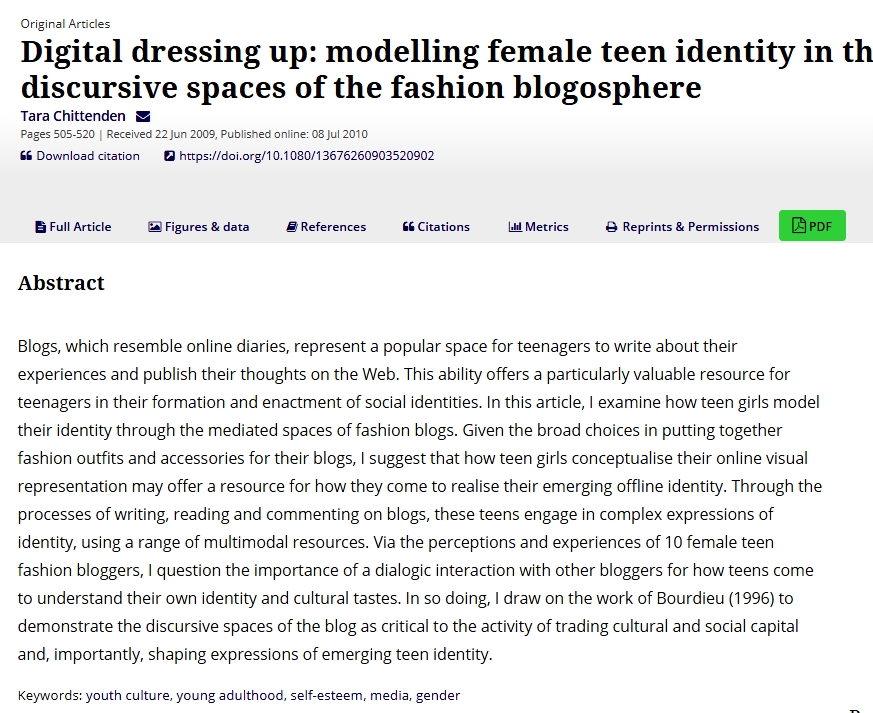
7)Chittenden, T. (2010, August). Ebscohost. Retrieved 2019.

Background: This document is about how teens specially girls have blog now that let them post anything they want. Teens basically use it to write their thoughts and experiences in public for everyone should see it for popularity. Specially what they wear when it comes to cloth and sneakers. Comments are getting every where getting other people opinions. Also, takls about how this blogs shoe teen identity and cultural background making people aware of there cultural difference.

How I used it: I used this to compare it with the popularity of sneakers because in this this blogs you also see the obsession with sneakers. You post something, let’s say the new Jordan’s. You will become popular and really loved because you can afford expensive things, Is like if you got money you are popular and having coll shoes makes that happen, while the other people who have cheap regular shoes don”t even have followers. It’s all about what pair of shoes you wear.

8) Grindlay, L. A. (1992, October 20). Dying to be this fashionable: Price tag for status clothing climbs to grim new high for students: [1* Edition]. Retrieved November 11, 2017,

Background: It’s telling us about the rates and the important on how problematic sneakers have become in the past years that is causing a big rate of violence. Not only sneakers but cloth. Now everything in fashion is involved.

How I used it: I wanted to show that in overall fashion in general is causing to much violence in a point that is coming to dangerous. It also, gives evidence on how many rates of violence happen in the past years.

9)Smith, K. (2016, October 20). The Science Behind Our Sneaker Addictions. Retrieved January 30, 2014.

Background: This document “The Science Behind OUR Sneakers Addition” is focus on how teens obsession is good by looking at it as something valuable. They believe it will increase their personal value when getting it.

How I used it: I used this to contradict why obsession with sneakers is not bad and how it keeps teens away from the drugs and alcohol. It gives a fair amount of evidence on how teens are better of thinking about sneakers instead of something else. Is like the scientific theory and analysis.

10) Keller, K. (2018, May 18). A Brief History of America’s Obsession With Sneakers.

Background: Bill Bowerman, the University of Oregon track coach while he was eating breakfast in the morning he thought a idea to make a shoe that his track students could run a surface apart from the track field. They called the shoe “Waffle-iron shoe. This became a Nike legend. This is how it starts and ends up becoming so big that it causes a big issue in the world. Especially when jealousy is in the middle of everything.

How I used it: I used this article to know when did all of this sneaker obsession started. It helped it understand that everything happens already when it starts, we just don’t know about it because we can’t predict the future. It gives us a understanding that with obsession more ideas come into the head.


Posted in Bibliography, chavanillo, Portfolio Chavanillo | Leave a comment

Annotated Bibliography-G90

Saez, E. (2018). Striking It Richer: The Evolution of Top Incomes in the United States. Inequality in the 21st Century,39-42. https://eml.berkeley.edu/~saez/saez-UStopincomes-2017.pdf

Background: This is a ghastly statistic that almost seems unbelievable. A large part of this income disparity has to do with automation. Cheaper labor equals larger profits. So when a corporation can find a way to cut costs they will. Whether that be lowering wages or turning to automation. This greed by corporations hurts workers within the private sector. Having to compete with machines by taking lowered or stifled wages make living comfortably extremely difficult and/or impossible.

I used this to show just how large the income inequality gap is so that it gives the reader some idea of just how out of hand it has gotten.

Top 1.0 percent reaches highest wages ever-up 157 percent since 1979. (n.d.). Retrieved from https://www.epi.org/blog/top-1-0-percent-reaches-highest-wages-ever-up-157-percent-since-1979/

Background: Which if just looking at the percentage for the bottom 90% looks great, however comparing it to the top .1% you can see just how outrageous it really is. In 1979 the average income for the bottom 90% was $29,608 while the top .1% earned $622,018. In 2017 on average the bottom 90% made $36,182 while the top .1% made $2,756,865. This ridiculous growth within nearly half a century has created more problems for the average U.S citizen.

I used this source to show the difference in growth between the 99% and the .1%. This shows the reader the absurdity of the rates of growth between the two.

Preliminary results of the basic income experiment: Self-perceived wellbeing improved, during the first year no effects on employment – News archive for customers. (n.d.). Retrieved from https://www.kela.fi/web/en/news-archive/-/asset_publisher/lN08GY2nIrZo/content/preliminary-results-of-the-basic-income-experiment-self-perceived-wellbeing-improved-during-the-first-year-no-effects-on-employment

Background: These findings show partially what was thought what a UBI would do. It did increase happiness. This could be for a multitude of reasons. It could be because they had a little more financial freedom, as in, they could pay bills they were worrying about, repay debts, eat healthier, etc. This is great in a democratic sense that these people were able to feel less hopeless and hopeful and confident for the future, but in a capitalistic sense it would be seen as a negative as the participants of the study’s job prospects didn’t really improve. According to Finland’s Labour Institute for Economic Research compared to the control group those who did receive money they worked on average .4 days more in 2017 and earned $24 less. This would show that nothing has changed in a capitalistic sense, but we also have to remember that this is just a one year chunk of a two year study. We won’t know until 2020 for the full results.


I used this source to show that even though a UBI might not help with job prospects that it gave the participants more confidence and optimism for the future.

Smith, A. (2010). An inquiry into the nature and causes of the wealth of nations. Charleston, SC: Bibiobazaar.

Background: but Adam Smith’s Labor Theory of Value would say that the income made by the worker for the company is the material expense and compensation for the work put in. Many other philosophers would disagree however.

I used this source to explain the Labor Theory of Value and how workers are exploited through labor.

Marx, K., & Engels, F. (1971). Capital by Karl Marx. Chicago: Encyclopaedia Britannica.

however a UBI would not necessarily fall under this system. Within a capitalistic society a UBI would be implemented sort of as a compromise between these two ideologies. A UBI would give the workers more value when it came to the development of goods and decrease income inequality between the different economic classes, while the capitalists still own the means of production and still make a profit, however at a much lower rate and at a more equal rate to the income of the workers.

I used this source to explain Marxism, but also how a UBI is a bridge between capitalism and Marxism.

Hunter, B. (2017, September 08). The Top Three Arguments against a Universal Basic Income | Brittany Hunter. Retrieved from https://fee.org/articles/the-top-three-arguments-against-a-universal-basic-income/

Background: One of the first arguments against a UBI is that it’s too expensive. This is true funding a UBI would require a raise in taxes and a rise in the U.S deficit, however this isn’t necessarily a bad thing.

I used this source to provide arguments against a UBI so that I could turn those arguments into strengths for a UBI

https://ticdata.treasury.gov/Publish/mfh.txt

Background: This is what keeps the U.S and many countries at peace and afloat. Most countries have invested within the debts of other countries. This encourages trade as a prosperous economy increases the purchasing power of that economies currency. This, in turn, increases the worth of the loan held by the foreign country.

I used this source to show who holds the U.S’s debt to make the argument that having federal debt isn’t necessarily a bad thing.

Canada’s Ontario government cuts basic income project short. (2018, August 01). Retrieved from https://www.bbc.com/news/world-us-canada-45023510

Background: If you look at a UBI in what studies have been conducted you can see that this isn’t enough money to live off of. The ideology behind a UBI is to allow for more economic freedom within a changing landscape with the rise of automation. Most participants in these studies anyway are also on welfare programs. To keep taxes lowered it would be logical to change where taxes are spent.

I used this source to show how much money was received by participants to show how difficult it would be to live off a UBI. This would prove that a UBI is more of a incentive than a handout.

Posted in Bibliography, g903254, Portfolio G90 | Leave a comment

Bibliography- hazelnutlatte

  1. Kesling, G. (2006, September 1). Ask the expert: The Case of Andrea Yates. Retrieved from http://eds.b.ebscohost.com/ehost/pdfviewer/pdfviewer?vid=5&sid=fe9d653a-63d8-4d3b-b270-20f26b85b43b%40sessionmgr102

Background: This source gave a description about the case of Andrea Yates, and tied the events of the homicide to her mental illnesses that she was diagnosed with. It described mostly her diagnoses of schizophrenia and postpartum depression.

How I used it: I used this source to gather further information about the case of Andre Yates. This source helped me describe the events what happened that night, along with the theories of why Yates had committed the crimes. I used it as support in my argument that Yates committed this crime because of her mental illnesses she suffered from.

2. Roche, T. (2002, March 18). Andrea Yates: More To The Story. Retrieved from http://content.time.com/time/nation/article/0,8599,218445,00.html

Background: This source explained the events of the trial instead of the actual murder itself. It explained how years after Yates was convicted, she was then found not guilty by reason of insanity due to her mental illnesses.

How I used it: I used this source to support my hypothesis that Andre Yates has committed murder due to the mental illnesses that she suffered from. It allowed me to back up my statement of why Yates was found not guilty by reason of insanity.

3. Diamond, S.A., (2008, May 2). Sympathy for the Devil. Retrieved from https://www.psychologytoday.com/us/blog/evil-deeds/200805/sympathy-the-devil

Background: This article focused on the two main mental illnesses that Andrea Yates was diagnosed with; schizophrenia and postpartum depression. It explained the effects of these illnesses and why they affected Yates tremendously.

How I used it: This allowed me to go into further detail in her mental illnesses and focus on two aspects that supported the idea that I talked about, not guilty by reason of insanity.

4. Poyatos-Leon, R.; Garcia-Hermoso, A.; Sanabria-Martinez, G.; Alvarez-Bueno, C; Cavero-Redondo, I.; Martinez-Vizcaino, V. (2017, June 6). Effects of exercise‐based interventions on postpartum depression: A meta‐analysis of randomized controlled trials. Retrieved from https://onlinelibrary.wiley.com/doi/full/10.1111/birt.12294

Background: This source gave background into postpartum depression and how it affects a person’s mental stability. There were tests done to show the decline in a person’s cognitive state, and how it affects their lives and those around them due to the strain that takes place to the victim.

How I used it: This source allowed me to give background and show evidence that showed how violent schizophrenics can be, and how drug use can affect the amount of violence. I talked about the statistics of schizophrenics abusing others versus the amount of abuse in schizophrenics who use drugs.

5. Stratton, J.; Brook, M.; Hanlon, R.E. (2016, February 10). Murder and Psychosis: Neuropsychological Profiles of Homicide Offenders with Schizophrenia. Retrieved from http://eds.b.ebscohost.com/ehost/pdfviewer/pdfviewer?vid=10&sid=b13e729e-d665-41b4-9734-94c9ecff5647%40pdc-v-sessmgr03

Background: This source described various cases that involved others who have diagnosed with schizophrenia and have committed murders. It described the actions that many schizophrenics take, the functioning they have in their brain when suffering from schizophrenia, and why it is linked it these murders.

How I used it: With this source, I gave examples of what other researchers have found in murders with schizophrenia. This allowed me to give evidence to support my hypothesis, and further explain how and why the Andrea Yates’ case came to the verdict of not guilty by reason of insanity.

6. “Schizophrenia.” National Institute of Mental Health, U.S. Department of Health and Human Services, http://www.nimh.nih.gov/health/topics/schizophrenia/index.shtml.

Background: This source gave more detailed descriptions on schizophrenia. It was more generalized and non specific to any case or person.

How I used it: I did a lot of research on schizophrenia because this was the main mental illness in the Andrea Yates case, and I was able to use this research to support and describe the effects of schizophrenia on the sufferer, and how it was a large factor in why Yates had committed the crime that she did.

7. “Andrea Yates Fast Facts.” CNN, Cable News Network, 21 June 2018, http://www.cnn.com/2013/03/25/us/andrea-yates-fast-facts/index.html.

Background: This was more of a popular source rather than scholarly but it gave insight into how the media looked at this case. It gave brief facts about the case and described how the case and the events of the case were being portrayed in the public eye. This allowed me to see how Yates was seen on a non professional/medical perspective.

How I used it: This article allowed me to gain a quick idea of the Andrea Yates case, on top of the rest of my in depth research. This was useful when beginning to describe the case so that I could quickly tell the reader what is believed to have happened in the media.

8. Cornell Legal Information Institute. https://www.law.cornell.edu/background/insane/insanity.html

Background: This source gave background information on the verdict of not guilty by reason of insanity. It explained why it is used and how the verdict is decided depending on the factors of the case.

How I used it: I used it in the definition part of my paper to describe how not guilty by reason of insanity was used in the Andrea Yates case.

9. Syed, R. (2013, June 19). Are You Really at Risk of Attack by Someone With Schizophrenia. Retrieved from http://theconversation.com/are-you-really-at-risk-of-attack-by-someone-with-schizophrenia-14656

Background: This source gave details about how people schizophrenia are not all violent and what other factors come into play that makes someone with schizophrenia become violent.

How I used it: I used this to help me support the idea that Yates became mentally insane due to schizophrenia, but throw in what other factors could have made her become violent on top of the disease.

Posted in 123 Uncheck this Box, Bibliography, hazelnutlatte, Portfolio Hazelnutlatte | Leave a comment

Research-rowanstudent

You’ve Been Tricked by Sham Medicine: The Deception Behind Placebos

By definition, a placebo is “a harmless pill, medicine, or procedure prescribed more for the psychological benefit to the patient than for any psychological effect.” While a placebo is used to create a mental state that does in fact promote well-being and healing, it can be argued whether it is “harmless.” Remedies for physical illness benefit from a positive mental outlook, at the same time a pessimistic outlook can make people feel increasingly sick. Even terminally ill patients can alleviate their suffering if they commit to a belief in their own cure. While no reputable physician would lay hands on a patient and advise him or her to assign a cure to a higher power, providing patients with a placebo has much the same effect in patients whose commitment to the curative power of the therapy is strong enough. The placebo effect effectively deceives patients into believing that they are receiving medication to heal them while leaving the actual work to their psychological systems. In addition to this, the inconsistency of studies regarding what’s called the placebo effect and the ethical issues surrounding the use of “illusionary medicine” by medical professionals create a moral ambiguity surrounding placebos and their uses.

Psychological factors play a key role in a placebo treatment. An individual’s brain decides whether treatments effectively work or not. Even if the placebo effect is deceptive, it still represents an alternative worth trying for patients who don’t respond to the application of more conventional medications and treatments. Placebos work differently between diseases, disorders and syndromes. While diseases and disorders can almost be used interchangeably, they are slightly different. Disease is the physical difficulty the body is facing; a disorder is the reaction the body is having to the disease. A syndrome is a mix of signs that suggest the possible disease associated with an illness. Placebos work most effectively in disorders as they can be mental rather than diseases where the physical body is in jeopardy. A placebo should cause “clinical improvement” according to the Journal of Neuroscience. Typically, this treatment is used for cases that involve the psychological part of the body. People that benefit more from it usually have fundamental trust in the medicine. They expect and believe that whatever is inside the medication, will alleviate their pain. Only when patients are unaware that their medication is a placebo and believe they are taking “real” medicine the placebo effect may have positive outcomes. However, this isn’t the case when patients know the medicine is a placebo. Harvard Medical School Professor and Director of the Harvard-wide Program in Placebo Studies, Dr. Ted J. Kaptchuk did a study on people with irritable bowel syndrome (IBS). This is a condition that causes pain in the abdominal area and diarrhea or constipation. While it is called a syndrome, it is based on a set of disorders in the patient’s body. Half of the study received an “open-label” placebo, while the other received no treatment at all. The results showed that there was a vast improvement with the placebo group’s symptoms even though they knew they were taking a placebo. This group also felt that their symptoms were lessened in severity and that relief was much more prominent, which in turn improved their quality of life. This questions the underlying reason for the deception of placebos. Is it better for the patient to be given an “open-label” placebo or to not take one at all? Is there a more beneficial effect on a patient who receives a placebo deceptively? According to the results of this study particularly, an “open-label” placebo gives patients a better benefit to their symptoms than ones who didn’t take anything at all. Which means they still work even without deception. It should, however, be noted that this was a study for just IBS, which means not all open-label placebo treatments will work the same in other disorders or diseases.

In the next study they analyzed what would occur when a physician gives a placebo to a person with Parkinson’s disease? A disease that involves the central nervous system, motor functions and dopamine production. For this study, patients were given a placebo, but were told that it was an antiparkinsonian drug that would help with their movements. They were injected with a saline solution that had no confirmed effect. Neuronal activity in the subthalamic nucleus was recorded before and after the procedure. The people who felt an effect showed actual bursting activity of neurons in the body, while the non-responsive group, didn’t show anything. This means that the cases in which the placebos worked the brain showed an increase of activity. If placebos are not real medicine and yet patients’ bodies are responding to the medication and they are experiencing psychological changes, would the same psychological treatment without the placebo intermediary have the same healing effect?  In other words, if a placebo is only supposed to be therapeutic, is it possible that a person’s mental abilities are strong enough to cure themselves? Placebos, may in fact, just be dependent on each patient’s mental state.

The Journal of Neuroscience did studies on different mechanisms of the placebo effect treatment. “The study of the placebo effect, at its core, is the study of how the context of beliefs and values shape brain processes related to perception and emotion and, ultimately, mental and physical health.” Fabrizio Benedetti says that if we want to see how a placebo affects a person in a psycho-social context, the placebo must be treated as a real treatment. Medical professionals must prescribe this treatment to trusting patients. Since there is a fundamental trust between medical professionals and patients the patients will most likely believe the treatment the doctor has prescribed. The response that the patient has is dependent on each individual person. Since a placebo isn’t supposed to have any actual psychological outcome, it depends on the mindset of the patient. The patient who has the desire to feel better will have a longer lasting benefit than the one who feels indifferent when both take a placebo. “It has been defined as the ‘positive physiological or psychological changes associated with the use of inert medications, sham procedures, or therapeutic symbols within a healthcare encounter'” according to Franklin G. Miller. There are many mechanisms on how to go about a placebo treatment. The most positive one in patients is the one referred to as “response expectancies.” Brain imaging techniques are being used to reveal the neurophysiological part of these expectations and the different mechanisms underlying placebo effects in many ways that depend on each individual person. A National Institutes of Health requested applications that stated, “understanding how to enhance the therapeutic benefits of placebo effect in clinical practice has the potential to significantly improve healthcare.” Open-mindedness to alternative medical therapies is the distinguishing characteristic shared by patients who report successful outcomes of placebo treatment. According to the Journal of Neuroscience, something as simple as having an expectancy can impact the neurobiological effects of a placebo. “The study of the placebo effect reflects a current neuroscientific thought that has as its central tenet the idea that ‘subjective’ constructs such as expectation and value have identifiable psychological bases, and that these bases are powerful modulators of basic perceptual, motor, and internal homeostatic processes.” This means that a placebo is just the factor that give the patients confidence in their ability to be healthy again.

In a study, conducted by Brian J. Anderson, Gerald A. Woollard, and Nicholas H. Holford, they recorded effects of Acetaminophen analgesia and placebo in children undergoing outpatient tonsillectomy. Acetaminophen is a brand of analgesic used to relieve pain. These children were randomly selected from a group of 9±3.0-year-olds with a weight of 37.9±16.6 kg. They were to respond with a pain score after taking either the drug or placebo after a certain period of time of 4-8 hours. The results showed that even in high dosage, the acetaminophen didn’t have much of an effect than a lower dosage of the same drug, and that it came with side effects such as nausea and vomiting. The placebo had a higher pain reduction than the acetaminophen. Even when combined, the pain reduction was less than the placebo effect by itself. In this study, placebos are counterproductive to the scientific basis of medicine. It even questions the ability of medicine to heal patients when faced against belief based medicine.

Due to the physical and psychological differences, it is more reasonable to believe that minor health conditions are the only treatable cases of placebos; symptoms that can be cured through off-the-counter drugs. They may include pain or depression or other slight side effects of a disorder, but not the actual disease. Placebo effects are outcomes that positively affect the patient even when it is known they are taking a placebo in the form of an inert substance. Providers who are part of a journal company for research in dermatology and venereology investigated the effect of the simplicity of someone’s voice to get rid of itch. 92 randomized volunteers were split up to be put to the test on whether open-label suggestions had a more significant change than a control group that received no suggestions. The results barely showed a difference between the two, but the placebo group had a slightly greater reduction in itch. This revealed that verbal treatments and explanations of the effect of placebos may play a key role in clinical methods. In a controlled trial of an open-label placebo, 46 randomized patients with allergic symptoms received placebos without deception or no pill at all. In the placebo group, positive recommendations about the placebo effect were given along with the treatment. A two week long trial showed that the open-label placebo group’s allergic symptoms had improved. According to the patients, the recommendation had no effects on their improvement. But it did help the overall well-being of the person and the “mental or emotional quality of life.”

In a study involving placebo effects and acupuncture, 12 people were interviewed at the start, middle, and end of a trial for Irritable Bowel Syndrome (IBS). Each person was told to give their thoughts on placebos. The four conceptualizations made were ‘placebos are necessary for research; placebo effects are fake; placebo acupuncture is not real acupuncture; placebos have real effects mediated by psychological mechanisms.” By the end of the trial, the results of the study were nearly half and half. Some believed had “positive conceptualizations” of placebos and others believed that people who had those conceptualizations were “gullible.” According to Franklin G. Miller, “the use of deception is considered necessary to understanding the placebo effect…” It is required to trick patients into thinking their health will improve. This creates an ethical concern for medical professionals. While some argue that placebos don’t require the use of malignant deception. The “major driving force” as Miller recalls is “response expectancy.” A common aspect of research focuses on deception. Some may say it is necessary to deceive patients by manipulating their expectations. The therapeutic outcomes reveal positive results after modifying patients’ assumptions. Both scientific methods and ethical standards are considered when using deception. When there is a balance between the two, the placebo effect does its job. Is “consideration” enough when it involves a patient’s health?

Back in its earliest uses, placebos led to “the evolution of the physician from witch doctor and priest-physician” according the American Journal of Psychotherapy. Galen estimated that 60% of patients had symptoms that were emotionally based, rather than physical. The medical treatments were not trustworthy, in addition they were rarely scientifically proven to work. Patients would ingest anything given to them. Their only concern was to get better, as a result, patients gave into “therapeutic practices” such as puking, leeching, shocking to name a few. Some are still used today like heating in the sauna, freezing in an ice bath or cupping to relax muscles. As bizarre as they sound today, patients still believed that there were lasting effects. Dr. Arthur K. Shapiro, M.D. stated “medicine was closely related to the finest scientific, religious, cultural, and ethical traditions in most periods of history…” This still seems unreasonable how traditions could have an impact on their health but once again it was the psychological reaction of belief. It has been proven by history however, most of these drugs and procedures were helpful only to particular patients. If not for the temporary aid these practices provided, physicians would not be giving such prescriptions today. The only reason for patients to have believe in successful results was the fact that psychological factors forced them to. Depending on the diagnosis at hand, the effect may sometimes lead to failure. Not every disease or disorder may be cured by psychological change. When analyzing the origin of placebos, it further questions the ethics surrounding the prescription of placebos.

Belief is different for everyone and each person has a belief that they feel strongly about. We can apply this to placebos. Whether one believes placebos work or not doesn’t matter. What matters is if the individual feels that it gives effective results. That can only remain true if the individual is susceptible to the idea that it will work. The worst thing for placebo-believers to hear is that placebos are a myth. Even if they do work, there is no real consistent scientific results. The only way for this scam medication to do its intended job is for it to be unknown to the patient. If a sick individual really wants to be healthy, they would do everything they can to get what they want. We can apply this to the placebo effect. Patients most of the time want to feel better, free of unnecessary stress and setbacks caused by the disorder they have. The solution to their ills is all about having the right mind-set. Having an optimistic personality would help as well. Only the patient can decide whether they feel better or not. Without the right attitude, it is very unlikely the patient will discover how to end their suffering. Since placebos are based solely on the psychological reaction based on belief, should doctors be involved in the belief-based system.

As said by Florida Law Review, placebos should have no effect on a patient’s health. The trust in placebos that physicians have nowadays are increasing at a rapid rate. If it’s cheaper and more efficient to use, then why not use them? The use of deception makes the therapeutic placebo seem like a real treatment. Some physicians believe placebos work and make their patients feel better, but they were not so sure how they worked. It makes no logical sense for medical professionals to participate in the prescription of a treatment which they don’t understand. In addition to this, the relationship between the physician and patient is affected by whether a placebo works on the patient or not. Proof of a powerful placebo will cause the medical world to question the practice of medicine. However, there is an inconsistency in determining if placebos do in fact work. If somehow proven that the placebo effect works, physicians may have to reconsider their methods of prescribing them. Not only does this affect the relationship between physician and patient, but also the legal team is involved now too. Lawyers are going to have to reexamine the degree of deception, these doctors will be allowed to use legally. With the proper consent of the patient, physicians may prescribe whatever placebo they think is needed. However, by definition, having actual consent would prove to be detrimental to the effect of the placebos.

The goal of the placebo effect is to be positive, but of course there is going to the negative aspect of it. It’s up to pharmaceutical companies and even the physician to emphasize the side effects, positive or negative, of the drug given to the patient. Without the ultimate use of deception, none of these scenarios would work anyways. Placebos are used mainly to heal a patient that has minor symptoms. They aren’t effective with diseases. Placebos can’t cure cancer or diabetes. They can, at most, help ease pain, but they will not cure these serious conditions. Due to the uncertain nature of placebos, the lack of scientific data, the questionable origin, and the level of deception related to placebos I believe it is unethical to allow physicians to negligently assign the cure of their patients to the placebo effect. By prescribing placebos medical professionals are in effect violating their Hippocratic oath to patients. In careers like medicine, or law, where professionals have an expertise in their fields which the common individual or common knowledge cannot fathom, there is a duty of transparency which is nonexistent in the practice of placebos. Only in cases where placebos are the only alternative available should they be used on patients.

References

Anderson, B. J., Woollard, G. A., & Holford, N. H. (2001, October). “Acetaminophen analgesia in children: Placebo effect and pain resolution after tonsillectomy.”Retrieved from https://link.springer.com/article/10.1007/s002280100367

Benedetti, F., Mayberg, H. S., & Christian S. Stohler, J. Z. (2005, November 09). “Neurobiological Mechanisms of the Placebo Effect.” Retrieved from http://www.jneurosci.org/content/25/45/10390.short

Bishop, F. L., Jacobson, E. E., Shaw, J. R., & Kaptchuk, T. J. (2012, January 18). “Scientific tools, fake treatments, or triggers for psychological healing: How clinical trial participants conceptualise placebos.” Retrieved from https://www.sciencedirect.com/science/article/abs/pii/S0277953612000160

Boozang, K. M. (2002). “The therapeutic placebo: The case for patient deception.” Florida Law Review, 54(4), 687-746. Retrieved from https://heinonline-org.ezproxy.rowan.edu/HOL/Page?collection=journals&handle=hein.journals/uflr54&id=716&men_tab=srchresults&t=1556592990

Kaptchuk, T. J., Friedlander, E., Kelley, J. M., Sanchez, M. N., Kokkotou, E., Singer, J. P., Lembo, A. J. (2010, December 22). “Placebos without Deception: A Randomized Controlled Trial in Irritable Bowel Syndrome.” Retrieved from https://journals.plos.org/plosone/article?id=10.1371/journal.pone.0015591#references

Marshall, M. (2016, June 23). “A placebo can work even when you know it’s a placebo.” (H. LeWine M.D., Ed.). Retrieved from https://www.health.harvard.edu/blog/placebo-can-work-even-know-placebo-201607079926

Meeuwis, S. H., Van Middendorp, H., VeldHuijzen, D. S., Van Laarhoven, A. I. M., De houwer, J., Lavrijsen, A. P. M., & Evers, A. W. M. (2018). “Placebo Effects of Open-label Verbal Suggestions on Itch.” Acta Dermato-Venereologica, 98(2), 268–274. Retrieved from https://doi-org.ezproxy.rowan.edu/10.2340/00015555-2823

Miller, F. G., Wendler, D., & Swartzman, L. C. (2005). “Deception in Research on the Placebo Effect.” PLoS Medicine, 2(9), 853–859. Retrieved from https://doi-org.ezproxy.rowan.edu/10.1371/journal.pmed.0020262

Schaefer, M., Sahin, T., & Berstecher, B. (2018). “Why do open-label placebos work? A randomized controlled trial of an open-label placebo induction with and without extended information about the placebo effect in allergic rhinitis.” PLoS ONE, 13(3), 1–14. Retrieved from https://doi-org.ezproxy.rowan.edu/10.1371/journal.pone.0192758

Shapiro, A. K., M.D. (2018, April 30). “Factors Contributing to the Placebo Effect.” Retrieved from https://psychotherapy.psychiatryonline.org/doi/abs/10.1176/appi.psychotherapy.1964.18.s1.73.73

Posted in Portfolio RowanStudent, Research, rowanstudent | Leave a comment

Research–Wazoo

A Corrupt System

Athletes all around the country train their whole lives for the chance to play at the division 1 level. These athletes have little interest in school and train because of their love for their respective sport. The idea of paying these college athletes is not far fetched. The NCAA makes a lot of money from athletes, and in return players receive stipends each month to take care of expenses, but this is equivalent to pocket change compared to what the NCAA makes.The NCAA takes advantage of their athletes by seducing them with luxury gifts. Scholarships are the form of pay for these guys and Scholarships are worth near nothing, and college basketball and football players in Division 1 need to be paid fairly for their contributions toward The NCAA.

The start of commercialized sports began in 1892, between Yale and Harvard. This was the beginning of the profit maximizing sports that we all know of today. (Beamon) The NCAA margin of profit is ridiculous. Schools started to overlook how smart people were and started to accept people solely on how talented they are at their sports. Colleges give out full scholarships to this day to athletes that do not even go to school for education. This depreciates the value of a scholarship. Scholarships were meant to be a reward for academic efforts earlier in life, and now most scholarships we see going out to students are athletic scholarships. These scholarships are not always full as well. Sometimes it only includes tuition, and sometimes its can be less than half. Just because schools say they give scholarships does not always mean that they are fully paid college and room and board contracts
With the athletes generating nearly 1 trillion dollars in the last 40 years, getting a degree and a well paying job would only account for 5% of their contribution. This is slavery. Although no one is being forced to do anything, they are enticed to work hard every year just to have the smallest chance to go pro. While all the executives and coaches are banking off of them. Athletes that do not make it pro are hurt the most from this system. After 4 years of grinding and generating your school millions, your left with a degree that is worth virtually nothing. No Special talent was developed because these schools pushed these kids through classes and pass them without them learning anything. Saquon Barkley of the New York Giants is a prime example of this. He would never go to class but then show up once for the exam and magically finish off with an A. Saquon is obviously in the league, but for most of his teammates in college, they will not be taking their talents to the next level. Now most of these guys are extremely un-educated. I think that’s what the university’s want just so no one is smart enough to speak out against them. It may have worked for years in the past, but this is a new era, people are getting smarter and sticking up for themselves more than ever. This situation is almost identical to the situation in the catholic church, when they would charge you so you don’t have to go to purgatory. Then came along Martin Luther and just like Luther, players today are breaking away from the norm and standing up for what they believe. They will not let the rich and powerful university’s take advantage of them anymore and in the future we could very well see a shift in power. power to the people.

College football and basketball is a business. Scholarships are not guaranteed and can be stripped for them at any time the programs feel they are not performing well enough for them. Schools can do this because they know there are thousands of kids that would kill to be in the spotlight and play for them. These players are considered amateurs, this is the argument NCAA chooses to side with of why they do not offer these guys contracts. If the NCAA does not want pay them, they shouldn’t advertise their athletes. The March Madness basketball tournament alone brings in an average of 80 million viewers. This generates billions of dollars for these schools, because on top of revenue generated from these events, it puts their school on a pedistal and attendance rate greatly increases as people go to some of these schools solely on the purpose of being a fan of their sports programs.

Scandals have started to come up all over the NCAA for football and basketball all the time. Schools that have exceptional athletes try to give them more than the 500$ stipend allowed. In 2010 the University of Southern California (USC) got sanctioned for their efforts to maintain running back Reggie Bush. USC bought Bush’s mother a new house rent free. As well as new cars and other non cash assets. This brought a lot of out lash because Bush was very poor and USC was just trying to help the kid out since they are not able to pay their players. Some people get angered by this because they think college athletes are armatures. Technically they might be, but they are generating revenue. It would be fair to pay the people that generate so much money for schools. ( Branch)

Athletes have such a disadvantage, because their is no union, and they are bossed around from the so called business of the NCAA. It is a monopoly that has total control over its employees. These athletes work for a business that doesn’t even pay them. If they are to speak up they are most likely kicked to the curb and told if they are not happy, then dont play. Pay to play is greatly impacted by public sentiment as well. The public still agrees with the fact that they are college students, but this is more of a jealousy factor over anything. People think that since they were not paid during their years, that athletes should wait to go pro. This logically makes sense so a common person that never played a sport, and doesn’t know how much time is put in to be good at a sport. It would be unfair if everyone was nationally televised and put in extreme pressures to perform, but thats not the case. These athletes are branded by their schools and bring in a huge cash flow, one that students do not bring to their universities. These athletes are not students working for a degree, they are already in a business working for a chance to move into another business.

The NCAA is full of profit craving sharks. These people only care about their pay checks and will do anything to increase them each year. They give the players lavish lifestyles to keep them happy. Players get to experience the 1st class life of the rich elite for the 4 years that they are in school. This keeps the athletes in a mindset where they only think about the now, and not what their futures will be like. With hundreds of millions being poured into stadiums and facilities, these players will have a life not many other people can live. Alabama just made an extension to their stadium totaling in over 600 million just on renovations. That should give you an idea on how much these top tier schools make off of their top sports. There are currently 6 executives in the NCAA that make north of 700,000$ a year. These people are working jobs where they direct and advertise other people to make money.

Athletes do not often speak up about not getting paid, because often they are offered illegal forms of pay. Athletes receive anything from houses to cars. This may seem like they are getting paid, but often these valuables are only short term. Along with the 500$ stipend each athlete receives, they get new phones, TVs, apple watches, gold chains, designer clothes and other expensive things to keep them happy, as well as fame. The fame doesnt last forever but for atleast the 4 years they are in school they have a chance to be the talk of espn journalists and other big news networks across the world. These goods often increase in value, depending on how big the game that they won. Along with trips to the white house and other ways they get to spend their time as champions. (if they win) It is not known to the public( I have multiple friends that play at the division 1 FCS level) but these things are often taken away from the athletes after their years are done in college. This is extremely disturbing because these athletes work so hard and the closest thing they get to pay only lasts during the time they are in college. There is no saving and the athletes do not get any richer while playing for the NCAA. When athletes win bowl games or big championship games, they are gifted with anything they want, from vacations to cars. This is not put out to the public and is one of the secrets of the NCAA. Maybe if people saw this they would agree on paying these players as short term professionals so they can legally receive a fair pay day.

Scholarships are opportunity. They path way for new lives for people who worked really hard to get it. It is a reward system for the few. Opportunity. One word means so much to what College is. What they give and who they help. They dedicate their lives to furthering human development. Without them there would never be an elite professional sport because everyone would just be under developed and average. They give individuals who come straight off the street and turn them into millionaires. How can one say they are bad people when Colleges are helping all these underprivileged kids succeed. They build the people that will eventually run our world and that doesn’t come at a free price, but they try to help and give students scholarships. It may seem extremely controversial that NCAA does not pay athletes, but they have a scholarship, and besides they are working to hopefully go pro. The money there is worth the wait. The whole point of being an ameature is to not get paid. You must work up the ranks in the sport and make it to pay level, if not Colleges still give free school to do something else with their lives. The NCAA is all about opportunity, but not about equality. You may disagree with their methods, but they don’t care because they will still make billions, also if athletes got paid, it would defeat the purpose of school. The price to attend these big schools will rise greatly. Students would also be asking for pay since the athletes get paid, and it would put colleges at a real disadvantage. Colleges’ infrastructure would start to crumble and all of these big schools would fall. In the end there wont be any schools for these athletes to play at, so there will be a ton of wasted talent all because athletes got greedy. College athletes are already on scholarship, so if colleges were to give them a pay day, They would take that away, and athletes would have to pay them, and for most of the athletes, they would be in debt, and not even have the free education anymore. One could say that scholarships are better then getting paid cash. College sports have been around for decades, the corrupt system needs to end and there needs to be Reform.

In Most Universities, athletics is held at a higher standard than education. Athletes are treated like superiors in society, and receive a lot of attention. Colleges try to make it so these guys can do the bare minimum and still get a degree, but there comes a time when services are not enough, and these guys need money. When players do not have enough money to return home over the summer, that’s when you know there is trouble. The NCAA makes over 1 billion dollars a year off of huge TV contracts, and they wont even give their players money so they can use their breaks. (Sanderson) Most universities are dedicated to athletics over academics for a number of reasons. One is that legislation. Most people enjoy Football and Basketball, and if schools dedicate most of their time and money toward sports, they will be allocated funds by the state toward their football programs, because most states have a large following backing their university’s sports programs. Another reason is that they may increase private donations if they prioritize sports. Famous athletes like Michael Jordan donate millions of dollars back to their Alma-mater as a thank you and for school pride. Just the presence of high profile sports greatly increases a schools likability. Many big schools like Penn State and Alabama would be virtually nothing if there were no big sports programs.

Scholarships are a terrible excuse to say its pay for athletes. These are not guaranteed and are worthless to athletes. They go to college to play not to learn. It is a way for colleges to save money, they provide a service instead of cash, so they save a ton of money. Corporations banking on these players such as Nike and Under Armour, are not even allowed to endorse them. Which I do not think they care about that rule because it saves them a ton of money and they are not taking any of the fall during this controversy if things were to go right and players are paid. Only University’s will pay for it, but these big businesses are just as much in the wrong as they brand the players with their logo, and support the argument that they receive scholarships, so they don’t need pay. The Same companies that market their business as being for the players. Players show off their shoes and market their brand and in return big corporations don’t even pay them. These sharks steal from the poor to make themselves richer and they do it on a promise of a contract if they go pro. The big key word is If. Most college athletes in the top earning sports do not make it to the pro level, but they still put in just as much time and energy as the ones that do make it.

Athletes that graduate as students have it the worst. These people got through their whole college career laying low and doing the bare minimum. Their diploma may say they graduated, but it does not say they are educated. They will go into fields where they may only last a short period of time due to lack of education toward their degree. This really hurts them because they have a worthless degree because jobs won’t hire people that do not know how to do the job their diploma says they know how to do. They are supposed to be experts in their field after college but instead wind up having freshman level academics. This causes many athletes to be unemployed or working jobs that didn’t even require a college education in the first place, like construction or part time football coach. Some of those jobs pay really good, but for a school to pay athletes with an education they didnt even use, while they gave them their talent for 4 years is un fair. Colleges are basically getting talent for free.

The men that run the NCAA are so rich and powerful, it is going to take more than just the athletes to get fair pay. We need to take action as well. The public needs to speak out against this more to create more change. These men that run this will not stop and the only way for them to start paying up is if we do something about it. Im not saying boycott the games or anything, but if we start a conversation and spread awareness about the real issues that are going on then maybe we can get some help from more powerful individuals that will help our cause. Reform is a must for the NCAA. They still operate on the same values when it was established in 1902. We need a more progressive platform that will support our players and change with time. The athletes deserve better and the NCAA won’t make it better without a change in the public’s heart.

As you can see, the NCAA’s corrupt values need to end. Instead of trying to hide the cars and other valuables players get, they should make their business legitimate and start signing players solely on the purpose of their sport. So Universitys can focus their scholarships on academic purposes. Nothing is free in this world and work shouldn’t be either. These players are making their schools millions, the least they could do is pay them. But it starts with the people starting a conversation. The players want to speak out but feel as if what they have is “good enough” but in reality they know for sure how badly they are being ripped off. If universitys dont want to change then these players will find other ways they can make money. It is a big waste of time going to school if one is only there for sports. They would go straight to the NFL but there are rules that you must play atleast 2 years of football before going pro, which is a way for the NCAA to ensure that they will never lose any money. The broke scholarships must come to an end and athletes must get what they deserve.

Sources:


Beamon, K. (2008). “Used Goods”: Former African American College Student-Athletes’ Perception of Exploitation by Division I Universities. The Journal of Negro Education,77(4), 352-364. Retrieved from http://www.jstor.org/stable/25608704


Branch, T. (2011, October). The Shame of College Sports. Retrieved April 29, 2019, from http://www.workplacebullying.org/multi/pdf/branch.pdf
h

Goplerud, C. (1997). Pay for play for college athletes: Now, more than ever. South Texas Law Review, 38(4), 1081-1106.


Hruby, P. (2019). Paying college athletes gaining a bipartisan consensus as new report slams NCAA.


Meggyesy, D. (n.d.). Athletes in big-time college sport. Retrieved from https://link.springer.com/article/10.1007/BF02686170?LI=true

Parent, C. M. (2004). Forward progress an analysis of whether student-athletes should be paid. Virginia Sports and Entertainment Law Journal, 3(2), 226-256.


Sanderson, A. R., & Siegfried, J. J. (2015, January/February). The Case for Paying College Athletes. Retrieved from https://www.jstor.org/stable/43194698?pq-origsite=summon&seq=1#metadata_info_tab_contents

Posted in Portfolio Wazoo, wazoo, x Research Position Paper | Leave a comment

Research-nousernamefound1

Furthering Students Education Matters

The prohibitively High Cost of attending college is CAUSING enrollment to drop. It’s not just 4-year colleges that are showing drops in enrollment. Community colleges have been in a drought for almost 10 years now. The process is becoming a major problem for low-income students and families. “Students from families that struggle to get by— including those who live in communities with lower shares of college-educated adults and attend high schools that have higher student-to-counselor ratios — tend to overestimate the true cost of higher education more than students from wealthier households in part because they are less aware of the financial aid for which they are eligible,” according to Michael Mitchell, Michael Leachman, and Kathleen Masterson in “Funding Down, Tuition Up.” Statistics are showing that most low-income families are people of color, which is why many people believe campus diversity is being jeopardized. When colleges make tuition and student fees higher to make more building, they forget about the issues that come with it. Issues like students not getting financial aid, campus diversity, enrollment decline, and bad performance in the classroom. We must stop believing that making something “Free” is the best way to solve things. We shouldn’t have a limit on something that is going to benefit us for a lifetime, but we shouldn’t be making the limit to where people are giving up on school.

The strategy to improve their status and appeal has backfired for schools that used tuition hikes to finance improvements to their campuses. Instead of giving out more money to help out students that want to further their education, colleges are more worried about the buildings. As a student, I could care less about what a dorm looks like or classroom. This is just my opinion, but I know many other students could verify this claim. Jon Marcus claims, in “The Paradox of New Buildings on Campus,” that “The problem is compounded by the fact that they nonetheless continue to build more—spending a record $11.5 billion last year—in the hope of attracting students at a time when enrollment is leveling off or falling.” The cost of attendance would attract more students than new buildings. Increasing tuition is a scapegoat for schools that need money for new buildings. Jon Marcus claims, in “The Paradox of New Buildings on Campus,” that “It’s an endless game of chasing your tail,” Swanson said. “Every year we lose ground and costs increase. And if we don’t get the money from the legislature, the only other place we have to get it is tuition.” In this case, many students are losing the chance to better themselves in life because of the school’s fetish for new buildings.

Education is treated as a business and to get the education we need for a better job; students must face these problems. I will always believe that we will go broke trying to get rich because of the fact that it cost us thousands of dollars just to get a few chances for a top notch job. Last year the number was at an all-time high, but this is not a problem because they rely on the students. Still, in spite of their financial woes, universities and colleges spent $11.5 billion last year on construction, an all-time high, according to Dodge Data & Analytics, a private company that tracks this,” according to Jon Marcus in “The Paradox of New Buildings on Campus. A building doesn’t attract students that just want a degree. My conclusion would be investing in programs that will guarantee more students being successful in private or public institutions. This would attract more students because it will show that the school really cares about us and doesn’t just want our money. As of today, claiming that schools don’t care about students will have a lot of people agreeing with students. They use tuition as a scapegoat to get out of financial trouble. Where does the money go? What are colleges buying? These are questions that constantly cross my mind as a student.

There are some shocking facts out there that will leave students and others shaking their head. Many say that colleges are expensive because of the fact that many of the institutions need more faculty members and they need to figure out how to pay them all. That dream house or dream car that we wanted for years can come to an end after noticing how much in debt we are in student loans. Hillary Hoffower in “College is more expensive than it’s ever been, and the 5 reasons why to suggest it’s only going to get worse,” claims that “At a four-year nonprofit private institution, tuition and room and board is $46,950, on average. Four-year public colleges charge an average of $20,770 a year for tuition, fees, and room and board. For out-of-state students, the total goes up to $36,420.” The numbers are ridiculous, we shouldn’t treat kids that want to better themselves like this. A lot of people miss out on this opportunity because of selfish institutions. Well, informed experts expect the drought to never change because of the fact that we rely so much on student aid to get kids into school. A director of strategic research at EAB stated that they absolutely need to be worried right now. This isn’t an issue that can be just pushed to the side. The problem has nothing to do with population. When colleges are losing over 50 percent of their students in the matriculation process, we are suspended to look within. When looking within the country can see that a lot of students are deciding to not attend because of financial reasons. We can’t blame this all on the government though.

The failure of schools to get kids to excel is a reason why the government is cutting back for community colleges. Ashley Smith claims in “No Bottom Yet in 2-Year College Enrollments”, that “EAB found that out of 100 students who apply to a two-year college, 56 are lost during onboarding, 23 drops out and just five are still enrolled after six years. Only nine of the 100 complete an associate degree and seven complete a bachelor’s degree.” The government will not waste their money trying to fund students when statistics show that they will just end up dropping out or even fail out. In this era, relying on student aid or government aid is like waiting around for pigs to start flying. In other words, it’s not happening. Ashley Smith claims in “No Bottom Yet in 2-Year College Enrollments,” that “Community colleges are used to declining enrollments when the economy is strong, and unemployment is low. But some researchers are warning colleges that future declines are only expected to get worse amid cuts in state funding and more pressure on institutions to produce measurable outcomes.” This is one of the few factors on why Community colleges have been in a drought for almost 10 years now. Some state schools give less financial aid to out-of-state students, which is why things can get a little expensive. Farran Powell in “Explore the Top Public National Universities,” claims that “Public colleges and universities often do not give enough financial aid to out-of-state students to make it an affordable option.”

Tuition doesn’t just damage the enrollment; it can also cause Demographic shifts. “Demographic shifts may be associated with changes in enrollment such as the growth of various subgroups or the population in general,” according to Nathan Lassila. 71 percent of students often use student loans to pay off school. That’s more than half, which makes me question the effort of colleges looking for a change. Lowering income students are still struggling until this day. In fact, a lot of them are paying more because they are not on the same rate as students that have a higher income. “However, there is a large gap in the ratio of low-income and higher-income students who enroll in post-secondary education,” according to Nathan Lassila. This is a fear for a lot of colleges, but still, they can’t seem to find a solution. If the numbers continue to grow schools will see the majority of the higher income families participate in college more than the lower income families. The cost and fees are causing a lot of students to throw in the towel. Why continue to wait on student aid when they’re cutting back? Institutions need a better solution when attacking this problem.

Colleges must first understand that a growing number of Americans live in poverty. Two would be that a lot of students are fighting for extra money, so when students try to do scholarships it doesn’t help the situation. It doesn’t help because institutions don’t give out enough scholarships for everybody. The amount of people struggling with the cost of attendance is way higher than the number of scholarships given out. They need to see that the cost scares a lot of students away. Nothing will change but the fact that enrollment will continue to decrease if they don’t take these baby steps. The institutions need to stop sitting around and waiting for a miracle to happen. Waiting around will do nothing but bring grey hairs. This is a serious issue that needs to be spoken on every day. There are too many jobs that require a lot of people to have higher education, but it seems like things will never change for the better for the students.

There are always two sides to the story, but one side always tries to bash the other group. In debate like this, we have the people that believe tuition should be lowered and others that don’t. Critics are so blind to the fact and it can show why there is no change for the better in the past decade. Instead of blaming the school for their actions, many are just blaming the government or personal beliefs. The people that are blind to tuition increase believe that we should stop making the mistake of going out of state to make your dreams come true. That out-of-state school will give us the same information that an in-state school would. The HEATH Resource Center at the National Youth Transitions Center claims that “The average tuition for an in-state student at a four-year public school for an undergraduate student was $6,752. The average tuition for an out-of-state student at a four-year public school for an undergraduate student was $15,742.” Students are too worried about getting away from parents and going buck wild. This is why we can see a lot of people bashing community colleges. They just want that experience of craziness.

Tuition is a problem, but it doesn’t have to be a problem for students. In other words, it’s our choice if we want to suffer from student debt. Community colleges, in-state schools, and scholarships all help students lower the cost of tuition. “Free” will not be the answer to this problem. People would just go to college for the parties if a college education was free. We need to remember that staff needs money too and if the school isn’t being funding how can they pay them for their efforts. Basically, this is a sign of being blind to a major issue. The schools are going to show no efforts to change when they have people like this backing them up.

Since nobody is taking that step for change, we as students must look into thing ourselves. This will not be a problem because at the end of the day we will be controlling our own future. Students have to take advantage of the opportunity rather than dwell on the ignorance of schools. When dealing with paying for college education, students should know how to get free money. In reality, a lot of students don’t understand how to qualify for more money. Students can find free money in Scholarships, Grants, Volunteer organizations, Athletics, Churches, etc. Christy Rakoczy in “Experts Reveal 19 Best Places to Find Free Money for College,” claims that “Plenty of students find scholarships and grants. In fact, college students received a total of $125.4 billion in grant money during the 2016-17 academic year.” As a student, we determine how we want to live our four years of college. We can either be stressed out or stress-free. We have a lot of organizations out there that understand that a lot of people need help when expanding their education. The claim that we haven’t made a step towards helping out students is false. The real issue is the students being too lazy and not wanting help.

Most of the time students are turning down free money because they don’t feel like typing a 500-word essay. Yes, they have some scammers out there on online sites, but students can ask their guidance counselor about legit ones. Students can also work for school while attending. This will help pay off some of the debt or eliminate some of the fees we are paying for. Becoming an RA may help students in the long run. When becoming an RA, students are rewarded free room and board. Students must take advantage of the opportunities that are out there, or they will suffer. Lowering tuition will be a process that will take a lot of years, so, for now, students must look into things that will help them pay for college. Christy Rakoczy in “Experts Reveal 19 Best Places to Find Free Money for College,” claims that “most students who start in their junior year of high school should be able to get at least some free money — usually around $300 to $5,000 — if they exhaust their options for free funding. The key is to get going and keep trying to apply until you hit the jackpot.” We often look for sympathy when looking for the change, instead of finding another path. Don’t complain about not having fun in school when you’re the reason for not having fun.

The institutions and students need to stop sitting around and waiting for a miracle to happen. Waiting around will do nothing but bring grey hairs. This is a serious issue that needs to be spoken on every day. There are too many jobs that require a lot of people to have higher education, but it seems like things will never change for the better for the students. School is not a choice when jobs are hiring people only with a college education. Jeffrey J. Selingo claims, in “College students say they want a degree for a job. Are they getting what they want,” that “a recent Harris Poll found that two-thirds of 14- to 23-year-old students want a degree to provide financial security, ranking it above all else when it comes to their motivation for going to college?” Working for 10$ an hour will not help our family forever, so how is going to college a choice? Nobody wants to rely on state funding and weekly McDonalds checks all their life. The mindset of these students is caused by the rising of tuition and stagnant wages. This is becoming a problem for schools because it makes it seem like 4-year Universities are turning into trade schools. They say that higher education is supposed to stay with us forever, but in this era, many students think it is just about the money we make after the 4 years. Of course, like every other topic, colleges are showing barely any progress to fix the mindset of students. “To prepare for the changing nature of work, colleges need to be more flexible in their academic offerings and employers in how they hire. That way, students will get what they want out of higher education and won’t fall into the trap of underemployment,” according to Jeffrey J. Selingo in “College students say they want a degree for a job. Are they getting what they want?” We face a lot of problems when it comes to further our education, so to help us out colleges should definitely lower tuition. We go through hell and back just to make our parents proud of us.

Leave the buildings and the adding staff alone and focus more on the kids. The numbers of enrollment will increase when the tuition decrease. “Over the last 20 years, the price of attending a four-year public college or university has grown significantly faster than the median income,” according to Michael Mitchell, Michael Leachman, and Kathleen Masterson in “Funding Down, Tuition Up.” I encourage all students and staff to demand change for the colleges. The problem with this country is that we are too late to speak on an issue. We wait and wait for the situation to become a crisis, then speak on it. We must deal with this situation now because a lot of people want that chance to further their education. We can’t blame this all on the government anymore. Tuition is a problem we face every day, but it doesn’t have to be a problem for students. In other words, it’s our choice if we want to suffer from student debt. Community colleges, in-state schools, and scholarships all help students lower the cost of tuition. “Free” will not be the answer to this problem. People would just go to college for the parties if a college education was free. We need to remember that staff needs money too and if the school isn’t being funding how can they pay them for their efforts. Students still have high-quality professors while attending a community college, so why not start there? Teachers are putting students in the right direction to become successful, but students are more focused on the aftermath. Stop thinking just because students are put into the top of the line dorms, introduced to groups that are focused on them, put in small size classes for easier learning, and have a bunch of people that have their back throughout the 4 years makes it okay for the number of attendance should be high. Lowering tuition or suffer from campus diversity.

Resources

Community college enrollment rates expected to keep falling. (2018, June 21). Retrieved March 24, 2019, from https://www.insidehighered.com/news/2018/06/21/community-college-enrollment-rates-expected-keep-falling

Explore the Top Public National Universities. (2018, September 25). Retrieved March 31, 2019, from https://www.usnews.com/education/best-colleges/slideshows/explore-the-10-top-public-national-universities

Funding Down, Tuition Up. (2017, October 11). Retrieved from https://www.cbpp.org/research/state-budget-and-tax/funding-down-tuition-up

Hoffower, H. (2018, July 08). College is more expensive than it’s ever been, and the 5 reasons why suggest it’s only going to get worse. Retrieved from https://www.businessinsider.com/why-is-college-so-expensive-2018-4

In-State vs. Out-of-State Tuition. Retrieved March 31, 2019, from https://www.heath.gwu.edu/state-vs-out-state-tuition

Lassila, Nathan E. (2011) “Effects of Tuition Price, Grant Aid, and Institutional Revenue on Low-Income Student Enrollment,” Journal of Student Financial Aid: Vol. 41: Iss. 3, Article 2. Available at: http://publications.nasfaa.org/jsfa/vol41/iss3/2 

Marcus, J. (2016, July 25). The Hidden Reason College Costs Keep Climbing. Retrieved from https://www.theatlantic.com/education/archive/2016/07/the-paradox-of-new-buildings-on-campus/492398/

Rakoczy, C. (2018, February 09). 19 Places to Find Free Money for College. Retrieved from https://studentloanhero.com/featured/free-money-for-college-grants-scholarships/

Selingo, J. J. (2018, September 01). College students say they want a degree for a job. Are they getting what they want? Retrieved from https://www.washingtonpost.com/news/grade-point/wp/2018/09/01/college-students-say-they-want-a-degree-for-a-job-are-they-getting-what-they-want/?noredirect=on&utm_term=.f85f084d4e74


Posted in 123 Uncheck this Box, nousernamefound, Portfolio NoUserNameFound, Research, x Research Position Paper | Leave a comment

Research: Nina

When speaking of incurable diseases and the suffering of patients with mental disorders, two options are made available. The first being euthanasia, the second being physician assisted suicide. Euthanasia is a method of the painless killing of a patient who is suffering a painful or incurable disease. The procedure is take place is a hospitable area and the patient is instructed by doctors and other medical professionals of the results of the procedure. In physician assisted suicide, if approved by a doctor and several other medical professionals, a patient does not necessarily have to suffer from an incurable disease to have approval of participating in the procedure.

There are many differences between both procedures. First, the reason for wanting the procedure. In the case of euthanasia, the patient who is requesting the procedure must have a terminal incurable disease and the family of the patient must agree. In assistant suicide, in Oregon for example, individuals who were of legal age, had the choice of an assisted suicide (Death with Dignity Law). The patient or client did not have suffer from an incurable disease.

Next, the biggest difference is the process of which both procedures occur. In euthanasia, once the patient is diagnosed with the terminal disease, if the doctor suggests or offers euthanasia as an alternative from suffering, the patient will make their decision. If the patient decides to prolong the procedure, he or she will than have to inform their family and complete counseling following up to the procedure. Then, the day of the procedure a drug know as pentobarbital is given to the patient by either IV or injection. Pentobarbital eventually makes the patient unconscious in one to two minutes and shuts down the brain and heart functions.

Next,there are three types of euthanasia, voluntary, non-voluntary, and involuntary. Voluntary euthanasia is done with the patients consent, and the patient understands his or her decision. Non-voluntary euthanasia is when the procedure is conducted on someone who was unable to consent due to their current health condition. In that scenario, another appropriate person, on the patients behalf can make the decision. Lastly, involuntary euthanasia is when the patient or a person is able to give consent but doesn’t and is forced to go through the procedure against their will.

To complete the procedure, there are two options the patient has active and passive. Passive euthanasia is when a medical professional offers strong doses of medication which will eventually become toxic to the patient. Active euthanasia is the use of a lethal substance to end a patients life. Active euthanasia is commonly argued and countered against moral, ethical, and religious reasoning.

On the other hand, in assisted suicide is more self reliant procedure. An individual will be administered a strong prescription of drugs.The patient has to sign a total of six to seven times a consent form for the procedure from the day they sign for the procedure to the day of. The reason for many signatures is so the patient doesn’t feel as though they have to proceed in the operation after changing his or her mind. Alongside the paper work, yet another form is asked to be signed 48 hours prior to the operation. Next, the day of the procedure the participant is given a bottle of prescription pills authorized by a doctor. With a physician alongside him or her, the participant is instructed to take the pills which will slowly put the patient into a deep coma. The patient is allowed to decide when he or she is ready to take the prescription drug.

Another means of difference between euthanasia and assisted suicide is the state of where each procedure can be performed. Active human euthanasia is legal outside the U.S in countries such as Belgium, the Netherlands, Columbia, and Canada. Assisted suicide is legal in Switzerland, Germany, and the Netherlands. In the U.S, assisted suicide is legal in Oregon, Washington, Vermont, Hawaii, Colorado, and California.

In the U.S, the states that allow physician assisted suicide have what is called a Death by Dignity law. This law allows terminally ill, qualified adults voluntarily request and receive a prescription drug to hasten their death. One of the most important elements when discussing assisted suicide is the state of mind the patient is in when making the decision. All states that have an active Death with Dignity law require that the patient has no history of extreme mental illness and is competent to make decisions. Though many who believe this counters the right to choose death at your own call, physicians and other medical professionals would not want patients applying for assisted suicide based on a drive of emotions.

When we speak on mental illnesses and strategies to either cope or help an individual, usually appointments of therapy treatments and medications are one of the very first thoughts. Hospital patients who are diagnosed as clinically depressed or extreme levels of anxiety are offered these option to help them through these times of hardships. Then there are patients who suffer from incurable diseases, such as polio and epilepsy, who depend on research and science to one day find a cure and get the help they need. Euthanasia, a practice that has been around as long as the seventeenth century. It has been an argument developed by doctors, state legislators and more for years to not be used as a method of treatment.

Already in the country of Belgium, laws of euthanasia were amended, authorizing doctors to take the life of any child, at any age, who makes the request to be euthanized. As for other places int he world, even with the exception of being terminally ill, euthanasia is not an option. For example in the case of 104 year old David Goodold, and Australian scientists last wish was to die. Due to reason that he was not terminally ill, but his wishes may be granted when he visits the End of LIfe clinic in Switzerland for voulantary euthanasia.

Not many see this as as problem because of his age and the fact that he understands his wishes, in fact many imply that “He has lived long enough to see everything”. Now, if we allow David Goodold to, someone who has no terminal or mental illness, to kill himself via voluntary euthanasia, what could this mean for those hundreds to thousands of other cases where individuals who suffer from depression would like to undergo euthanasia. To understand what the cause would be for allowing assisted suicides, we must acknowledge the other age groups.

Teen suicide is the third leading cause of death in youths between the ages 12 and 19. Up to twenty percent of teens suffer some sort of depression before the age of 24. For many options such as Interpersonal therapy (IPT) and Cognitive Behavior Therapy (CBT). To an extant, not all people can be saved by therapy and interpersonal counseling. Can euthanasia be an option? If a 104 year old can have his wished granted for assisted suicide, why can’t a teen?

If we allowed for assisted suicide in teen and young adults it will cause of number of mass suicide in teens because the option to die is available. This will occur because no one will look to the first alternative options of IPT and CBT when the outcome they want is at the tip of their fingers. Assisted suicide options are seen as “utilitarian” to allow assisted suicide because it respects the decisions and wished of dying or distress patients.

The slippery slope argument is that we want to respect the wishes of those who want to be assisted in their suicide but if we allow euthanasia for the elderly and not the youth, it wont be utilitarian to no respect their decisions. Yet to allow this can lead to mass assisted suicide in teens, young adults, and in elders.

The argument of assisted suicide and its “easy access” to assist people in the alternative to help depression has patients and clinically diagnosed patients on a slippery slope. In Oregon, the “Death with Dignity” law allows individuals to receive doctor prescribed medication and us w the given instructions as followed to complete the procedure of death. Physicians are to be next to the patient as they complete the procedure in case any last minute changes are to come as an inconvenience. A survey was taken in Washington D.C, where over 1335 physicians were eligible to take a survey regarding their position on assisted suicide. Sixty nine percent of physicians completed, the results showed that forty two percent (42%) of physicians say that assisted suicide is never ethically justified, and another forty two percent (42%) disagreed. Out of the sixty nine percent (69%) of physicians that participated in the survey, only thirty three percent (33%) will be willing to perform the procedure.

Physicians argue that if patients are eligible for assisted suicide, it will contribute to the utilitarian ways of the rights of human beings. But, if encourage individuals to choose when they die with no legitimate reason all because it is “utilitarian” is morally unethical. This will lead to a number of people asking for assisted suicide due to a drive of emotions only because the option is available. This practice not only affects the person pursuing the procedure, it passes on the suffering to other similar people, who will fear they are the next person to be seen as having a worthless life. Physicians will counter this argument that their jobs are to be healers and ease pain. Although assisted suicide may help relive a patient of pain and suffering, the role of a healer is incompatible and would cause more harm than good.

Most conversations that surround abolishing the law in places where assisted suicide is legal has been introduced. In Oregon, one of the seven states in America where assisted suicide is legal show fear of the opponents of law who want to abolish the Death with Dignity law. Many are astonished that they will have to face chronic, agonizing, pain rather then the option of assisted suicide. Though facing this dilemma will rise questions about the fate of ill citizens, assisted suicide is a profit driven system. Meaning, insurers and physicians are doing what is the ” cheaper” option rather than a series of expensive treatments and medicine. So, if an insurer were to deny someone of assisted suicide, the only fatal measure is clinics losing money from unperformed operations.

Physicians would continue to argue that Physician Assisted Suicide (P.A.S) is like autonomy and bodily integrity as a marriage or relationship. Patients can determine what they want to commit to and when. On the contrary, this would be giving doctors and specialist the choice of whether or not you are eligible to receive P.A.S. Professionals and legislatures will have the power to choose who lives and who dies. We have the right to pursue life, not to pursue death. Yet another physicians obligation to assisted suicide is that their job is to assist in helping people die more comfortably. Easing the pain through a series of painless options for the procedure. In contrast, the physicians job is to tell the patient whats wrong and offer options of healing. Physicians are not operating the procedures because patients have six months, and even a forty-eight hour reassurance period up to the day of the procedure to decide if P.A.S is a remaining option.

References

Asch, D. A. (2017, May 23). The Role of Critical Care Nurses in Euthanasia and Assisted Suicide | NEJM. Retrieved from https://www.nejm.org/doi/full/10.1056/NEJM199605233342106

How to Access and Use Death with Dignity Laws. (n.d.). Retrieved from https://www.deathwithdignity.org/learn/access

Nordqvist, C. (2018, December 17). Euthanasia and assisted suicide: What are they and what do they mean? Retrieved from https://www.medicalnewstoday.com/articles/182951.php

Dryden-Edwards, R. (n.d.). Teen Depression Facts, Treatment, Symptoms, Statistics & Tests. Retrieved from https://www.medicinenet.com/teen_depression/article.htm

Morrow, A. (n.d.). Why Do People Seek Physician-Assisted Suicide? Retrieved from https://www.verywellhealth.com/reasons-for-seeking-physician-assisted-suicide-1132378

Draper, B. M. (2015). Suicidal behavior and assisted suicide in dementia. International Psychogeriatrics, 27(10), 1601-1611. doi:10.1017/S1041610215000629

Top 10 Pro & Con Arguments. (2018, September 10). Retrieved from https://euthanasia.procon.org/view.resource.php?resourceID=000126

Diekstra, R. F. W., & DIEKSTRA, R. F. W. (1995). Dying in dignity: The pros and cons of assisted suicide. Psychiatry and Clinical Neurosciences, 49(1), S139-S148. doi:10.1111/j.1440-1819.1995.tb01917.x


Posted in 123 Uncheck this Box, nina, Research | Leave a comment

Research-Jets1313

The Unjust Criminal Justice System

Socio-economic status, high profile lawyers, the media and an unbalanced criminal justice system are are all inter-related. One of the many factors which has an impact on the criminal justice system is the societal and economic status of both the criminal and the lawyer representing them. High profile people are capable of hiring high profile lawyers. This therefore provides a criminal with the capability of hiring a well-read attorney and having an advantage when it comes to arguing their case. Additionally, lawyers of high stature have been known to find ways to keep their clients out of jail that are not necessarily legal or lawful. Certain attorneys seek through their clients methods to publicize themselves and make more money off of the high profile cases despite knowledge that their client is guilty. These tactics used by lawyers help to create a criminal justice system that is unbalanced and unequal to all criminals. This is undoubtedly a contributing factor as to why celebrities are given unlawful and special treatment in the court of law. As a result of high-profile lawyers utilizing illegal tactics, manipulating the media, and utilizing other resources which the average citizen does not have, they assist in creating a corrupt and unbalanced criminal justice system. These sorts of unfair methods are best exemplified when it comes to celebrity trial.

The justice system seems as though it has an entirely different system for normal middle and lower class people versus high-class people, thus, exhibiting a very unfair process. While it is understood that celebrities pay their lawyers more than an average person, it is not lawful that celebrity criminals are treated better in court, where they will be shown much more respect and privacy, if they so choose, than an average person with a public defender. Just because they pay their lawyers more doesn’t mean that they are above the law. This is not how the criminal justice system is supposed to work as there should be one unified government that represents all people equally regardless of the amount of money they have in their bank account. There are people who believe differently, that there is no problem with the justice system, or that the justice system is harsher when it comes to high profile criminals.

Concerning my thesis, high profile lawyers by definition are well-respected lawyers of higher notoriety in our justice system, that can gain media attention and are usually only available to wealthy people who need a specific type of lawyer for their case. These types of lawyers take cases that involve celebrities, cases that involve a lot of money and cases where somebody needs to be represented by a very credible person. This means that they are paid a lot more by their clients, and usually, the only people that can afford them also have a high profile. These lawyers are not easily obtained and definitely are not up for grabs. High profile lawyers are private lawyers most of the time and are very selective with their clientele. As explained in an article written by H. Patrick Furman called “Publicity in High Profile Criminal Cases,” these lawyers also have connections and power in the media that is higher than that of a public defender. This means that a client of higher status may have more options and and more protection from the outside world when it comes to their case. I️n other words, they will have much more privacy if that is what they want, or they can have their story highly publicized if that is what they think will help them. At the time of sentencing this will help the defendant because a jury may create a specific opinion that is influenced by a tabloid. This isn’t necessarily possible for a person that isn’t of a high profile considering they do not have the resource of money to protect their privacy. If we take into consideration the case of OJ Simpson, for example, he was originally found not guilty of murder even though all evidence suggested he was guilty of the crime. Years later he was given a much harsher sentence in response to a robbery he committed. An article by Carmen M. Cusack titled “Celebrity Justice and Gossip Blogs: Demographic Characteristics of Victimized and Allegedly Criminal Celebrities Featured on Top Gossip Blogs” explains why it was likely he was given this sentence years later. “Because the verdict happened to defy traditional biases, some observers claimed that Simpson’s jury intentionally attempted to establish equality by countering past biases inflicted by police forces and other criminal justice members.” This provides an example of how members of the criminal justice system have been unjust for years and letting celebrities and high profile criminals get away with crimes. Although, now OJ Simpson has gotten a large sentence to make up for what he should’ve gotten in the past, most high profile criminals do not commit another crime to be able to serve the time they should have. If OJ would have been found guilty in the first place like he should have been, he wouldn’t have been able to commit another crime and further cause injury to anyone else.

Additionally, high profile attorneys and their clients have an ability to manipulate the press, whether it be privacy or over-exposure. This sort of advantage is frequently allowed when the attorney or client has a favorable reputation. As explained in “Celebrity Justice” by John Gilbeaut, some “lay the blame on wealthy defendants who can afford to carry on fights not only to clear their names, but to keep them out of the newspapers and off the evening news, not to mention the super- market racks.” Sometimes, it isn’t the lawyers doing this deed but the people that they are defending who are in danger of losing reputations. By the same token, when it comes to desired increased media exposure, high profile lawyers will not only try to win their case but also act on intentions of gaining media attention for their benefit. It is explained in the article “Publicity in High Profile Criminal Cases” that “it seemed that the lawyers spent more time in front of the camera than in front of the bench. Ironically, after the trial, half of the lawyers got their own television shows.” This exemplifies a high profile lawyers own individual motivation to gain media coverage during and after a major case, providing them with a very lucrative reputation. This very well may be their only reasoning behind taking the sorts of cases they do.

Contributing to this, it is possible that people (and juries) will choose to side with a celebrity or their lawyer based on their status or past reputation. In an article by Bruce A. Corroll titled “Celebrity Adjudication: Comparative Analyses of United States Verdict Rates for Celebrity Defendants”, it is explained that “this combination of a susceptible jury, a strong media-influence, and celebrity presence can cause the jury to render a judgment that is biased by the media at the expense of a fair judicial preceding…”. This overall plays a large role in why these cases are notorious for exposing the imbalance of the United States Criminal Justice System. An “impartial” jury is, after all, one of the most sacred tenants of law when it comes to trial. Lawyers that represent high profile criminals are also characteristically known to not handle their cases professionally due to media attention. This idea is explained by Patrick Furman; he says “these [cases] are also precisely the cases which are most likely to tempt us into behaving out of character and unprofessionally.” This is a cause of an unfair justice system because these high profile lawyers are not doing their jobs correctly and still usually getting justice for their clients. Acting unjustly in a court of law is not allowed and is illegal, but, unfortunately we are still allowing people with a lot of money to get away with breaches of the law.

Noting this, an unbalanced criminal justice system has been a problem since the beginning of time. There will never be a perfect way to balance a system based on two things, guilty and not guilty. In our justice system, that is what is expected. In a world where nothing is ever black and white, it is hard to find a way for justice to be found. However, our criminal justice system has come moderately close to figuring it out. The balance, however, is being disturbed by the fact that not everyone can get the same type of defense. People with more money are getting off more easily, and it is not fair that someone whose only option is a public defender does not get the same type of representation as someone who has a high profile lawyer. An unbalanced criminal justice system is a system by which the courts treat a person differently than they treat other people because of their status. According to an article titled “Celebrity Justice” by John Gibeaut “advocates say today’s unmatched effort at secrecy cheats the public out of its First Amendment right to observe and criticize the system through its surrogates in the press. Ideally, public oversight is supposed to keep the system honest.” As regular people, when we go to court, our cases are heard by a public jury, where they vote on whether we are innocent or not. Just because our stories don’t end up in the media and all over tabloids doesn’t mean its not public information just like a person of a higher profile. Lawyers that represent high profile criminals also tend to try to keep the story out of the media and cover it up. This is unjust as well because freedom of the press is an amendment and should not be overlooked just because of the amount of money someone is paying to get rid of it, Gilbeaut says that “media advocates say today’s unmatched effort at secrecy cheats the public out of its First Amendment right to observe and criticize the system through its surrogates in the press. Ideally, public oversight is supposed to keep the system honest.” How can our system be honest if we are being silenced? In order to have a justice system that is fair for everyone in the country we need to put a stop to the people who are trying to hide the truth from the media. H. Patrick Furman believes “a free and vigorous press is critical to the proper functioning of our democracy.” A free and vigorous press is indeed vital to our government, as long as it is accurate.

Furthermore, the ability of the press to impact public opinion on the justice system in relation to both celebrity and average citizens plays a crucial role. An article titled “Dealing with the Press in High-Profile Cases, How to neutralize the 13th Juror” by Ellen C. Brotman helped me to understand that “high-profile cases have high-profile clients whose reputations can be ruined no matter what the outcome”. But, does this mean that the average person’s reputation can’t be ruined as well? Definitely not. So why is it fair that high profile criminals with high profile lawyers are so easily protected from ruined reputations and the media, but regular criminals are not? Discussing this concept of the perception of the world being warped by the press, Patrick Furman notes that the world is not shown the reality of the cases in many situations, and this causes “the image [to become] as important as the substance-a bizarre and unsettling state of affairs to those of us who value reality.” A jury would be completely unable to make a fair judgment of a person if their opinions were supported by fake news reports that they’ve seen and read about in tabloids. The criminal justice system would rather close the case when it comes to a high profile criminal rather than find actual justice. It is clear to me that the only reason for this is to keep everything quiet, keep everyones reputations clear and to keep all of their money. However, is this fair to the people who are not of a high profile whose cases also are part of a public record? Definitely not. “Celebrity Justice” by John Gibeaut explains how this helps to “[create] the appearance of a two-tiered justice system-one for celebrities and the other for everyone else-media”. This just further explains how unbalanced and unjust our system is when it comes to higher profile cases. Celebrity criminals can protect their reputations while criminals that are represented by public defenders, other lawyers, etc… are forced to take on the media and public backlash with no defense. However, no matter what your status is, what class you are, everyone’s cases should be presented to the public. If you are of a higher status, it should be expected by yourself and whoever is representing you that this will somehow get into the media. Because this is a huge issue for defendents, there is something being sone to help try to protect everyones rights. There are websites that the media has access to with only certain information. Author John Gilbeaut further explains that this is to “[make] it more difficult for media lawyers to argue for access when they don’t know a document’s contents.” In addition “the lawyers and judge speaking in court refer to documents in a code that only they understand.” This insures that the media cannot try to fabricate things before they are public knowledge because they will have no idea what the lawyers are even talking about. This is an important step in creating a government that is stable and fair for all classes of people.

While the media can help a criminal case, it is known that it can be detrimental as well. An article titled “Televised Trials: Weighing Advantages against Disadvantages” by Susanna R. Barber states, “Trial publicity may serve a crime control function and reassure viewers that justice is being served, but this same publicity encourages negative perceptions of criminals and fosters prejudice against defendants.”. This explains that yes, having a case that is publicized and open for interpretation by the world is fair and is one of our rights in this country, but, also that this type of exposure to a case can be detrimental to the defendants’ case. Thus, giving them a disadvantage over a less high profile case. While it is noticed “that television exposure is a form of public punishment, leading to permanent stigmatization in the eyes of the community”. In other words, those involved in these cases may gain a shameful reputation after the case is closed, even if they are found not guilty simply because of the negative exposure their case obtained in the media. This explains why high profile lawyers continue to try to keep media coverage low, but it also is unfair. Some may also argue that these criminals are placed under a microscope and all of their mistakes are played out in front of not only a court but the entire world. “Preparing for the High Profile Case: An Omnibus Treatment for Judges and Lawyers,” an article was written by Gerald T. Wetherington, Hanson Lawton and Donald I. Pollock explores the idea that not only are the criminals at a disadvantage, but also the judges and lawyers taking on the case. They share information that proves that the defendants aren’t the only ones being criticized. They say that “A judge who is assigned to preside over a high profile case should expect to be confronted with an explosive free press and fair trial issues even before the first scheduled hearing.”. These judges are forced to deal with the backlash of the media and public outburst before the case is even closed. While I do understand these points of view, it is important also to see that the lawyers and judges should be prepared for this type of thing when taking on these cases. The high profile criminals aren’t the only ones that receive bad press; however, regular criminals, most of the time are also shown in the media in a terrible light. So, while criminals with more money are mostly protected by their fancy lawyers from a lot of the media backlash, normal people do not have this luxury. Regular criminals are forced to have their faces plastered on social media with untrue headings and have absolutely no one to pay these people to stop. Another point that is important to realize is that so much money is involved in high profile cases that the court needs to be ready for all of the financial responsibilities that are to come and can replenish their losses at the end. Gerald T. Wetherington, Hanson Lawton and Donald I. Pollock also explain that so much publicity comes before the case is even in court for high profile criminals that, “the necessity for court officers to begin preparations to handle the extraordinary judicial management problems that such cases generate.” In this case, the disadvantage is that both the court and the defendant could lose a lot of money in this process. Although this may be true, it is also possible that the majority of the time the high profile criminals are getting off easier because this would be less expensive for all parties involved.

An unbalanced criminal justice system and the power of high profile lawyers have a strong correlation as one of these is the cause of another. It is important to realize that not everyone will have the same opinion as you. Celebrities are treated better than average criminals is an unorthodox idea and some people believe that these high profile cases are at a disadvantage. Others believe that celebrity criminals can lose everything in a court of law just like anybody else; however, from my point of view, high profile lawyers and their ability to impact the media as well as the jury cause this system to be unbalanced. Of course, some of these lawyers do actually abide by the law and go about their job professionally and lawfully, but, for the ones that do not it is very obvious. Lawyers of high profile criminals tend to try to find ways around the law and execute ways to make the most money, or lose the least. Money is power in our criminal justice system today, and this is not the way it is supposed to be. High profile lawyers seem to try to get rich off of their rich clients, do not represent low-class defendants and use their reputation to unfairly and unjustly support their clients. They do not always use legitimate strategies when it comes to defending their clients. The criminal justice system was supposed to be built on amendments that protect the rights of every person, criminal or not, and we are all supposed to be treated equally in a court of law. People of the lower and middle class a lot of the time do not have access to these kinds of lawyers or resources; therefore they do no get the same type of representation. The justice system does not need to be this way. The appeal is understood that there should not be one type of lawyer for every type of case, as everyone is different and has different things they need when looking for someone to represent them. What is outragious, is the idea that people with more money should be able to wiggle their way around the law.

References

Wetherington, G. T.; Lawton, H.; Pollock, D. I. (1999). Preparing for the high profile case: An omnibus treatment for judges and lawyers. Florida Law Review 51(3), 425-488.

Cusack, C. M. (2013). Celebrity Justice and Gossip Blogs: Demographic Characteristics of Victimized and Allegedly Criminal Celebrities Featured on Top Gossip Blogs. Journal of Law and Social Deviance 5, 244-297.

Gibeaut, J. (2005). Celebrity justice. ABA Journal 91(1), 43-49.

Brotman, E. C. (2015). Dealing with the press in high-profile cases: How to neutralize the 13th juror. Litigation 41(4), 40-44.

Barber, S. R. (1985). Televised trials: Weighing advantages against disadvantages. Justice System Journal10(3), 279-291.

Carroll, B. A. (2013). Celebrity adjudication: Comparative analysis of united states verdict rates for celebrity defendants. Entertainment and Sports Law Journal 11(1), 1-8.

Furman, H. (1998). Publicity in high profile criminal cases. St. Thomas Law Review10(3), 507-536.

Posted in jets, Portfolio Jets1313, x Research Position Paper | Leave a comment

Stephen Hawking Was Wrong

I shared this post with you today in class before I found this perfect expression of why we can always say with confidence that “the scientist was wrong.”

The opening joke (attributed to Albert Einstein) tells the whole story.

How to Demand Your Readers’ Attention.

This is a post in progress. It began from an interaction with a student named 3G last semester, whose research topic was black holes. Our exchange included the following: 

I love your topic, 3G, and I’m always intrigued to read your newest draft. But despite my interest, you nearly talk me out of continuing by starting out so slowly.

That’s an exaggeration, but it got your interest, didn’t it?

Case in point. Start out by grabbing my attention.

Nothing could be LESS surprising than that Stephen Hawking is a smart guy. Nothing could be MORE arresting than to claim that he was wrong. So say he was wrong.

Stephen Hawking was wrong about black holes. Long and rightly praised as one of the most intelligent minds of our time and the most innovative influencer in astrophysics, Hawking’s theories on the properties of black holes are considered gospel truth. Sadly, they’re most likely incorrect.

No matter how much “qualifying” you have to do to rebuild the man’s contributions after that opening, the tactic will be worth it if you have the evidence to demonstrate his mistakes.

Plus, it’s fun. And it makes me want to read on.

Are you up for that?

Followed by this followup:

Having read to the end of the essay now, 3G, I want to revise my opening gambit. Not only was Stephen Hawking most likely WRONG, but also his theories ARE PREVENTING right answers from emerging to take their place!

Jerk.

Followed by this: 

Finally, when I read these short arguments outside the context of the overall research project, I feel things missing that might exist in the other arguments.

For example, I’m sure you don’t mean to suggest that anybody’s scientific theories are ever considered TRUE FOREVER. Every proved hypothesis is immediately tested by new theories that attempt to build on the proved ones or overturn them if they can’t stand up for themselves. So, it’s good-natured teasing to call Hawking wrong. You don’t acknowledge that here.

And really, this is my last comment for now: If wormholes are just silly nonsense, any criticism of Hawking’s repudiation-in-advance of their existence will turn out to be pretty silly too. It’s just as likely that the radiation theory IS and SHOULD BE a warning to astrophysicists everywhere that the search for proof of wormholes—cool as they sound—will be a dead end.

Causal rewrite-3g

Posted in 123 Uncheck this Box | Leave a comment