
What a hook. (You might know Jeff Buckley’s version.)
What a hook. (You might know Jeff Buckley’s version.)
They’d be a local band if they hadn’t disbanded. Pity. They rocked.
Currency is a unique concept to think about. From fei, to dollars, to gold, it is a hard thing to really think about. People do not even see most of the money they own the closest they get to seeing it is the ATM slip with their current balance on it. People believe that they have as much money as their bank account says, but in reality they cannot spend their paychecks without cashing them into the bank. From reading about fei and about the Federal Reserve Bank transferred gold to the Bank in France I have realized that these two events are the basis on what the bank systems use. With the Germans taking the fei and putting their names on it, then when they got what they wanted which was the repaired path they took their names (the black cross marks) off of the fei . Same with the Federal Reserve Bank they just took their gold and put it in a drawer and labeled it “French”. I am dumbfounded because that is how all money is, and people cannot do anything about it unless they have every single dollar out of your bank account in your possession, like in your closet or something. You have to trust in the bank that all your money is in their though, because your not going to see it, and it really is believing in what you cannot see. By believing in your bank credit cards and debit cards are a huge asset because you will not need to carry around any cash and can have all of your money with you in your wallet. One plastic card will be able to replace all money, most people do not even pay cash anymore. Vending machines, parking meters, and many other machines that used to only take coins and dollar bills are now using credit and debit cards. Dollar bills and coins will not be a necessity, credit cards and debit cards will take over as money.
Joe Zawinul on the keyboards, Wayne Shorter on soprano saxophone. This is in my head at least once a day.
Nothing but female voices from Belgium, AFrica, island nations.
A little something from an early jazz fusion pioneer of the 1970s.
At first, the story of the people of Yap sounded completely foreign and abstract to me. I thought they were some fictional people with very ambitious methods of presenting wealth because of the massiveness of their currency, fei. I couldn’t grasp how these people could put so much trust in one another that they didn’t have to be in physical possession of the money to spend it. It had been my understanding that in today’s societies, money is really just a system of numbers that has arbitrary values depending on the society. I thought the value of money was really set by the government. However, now I know that money only has value if individuals are willing to trade for it. Those in charge of selling items, such as bread, will come up with prices they deem appropriate. This is where matters become very intricate. During periods of high inflation, because more money is available to the public, prices rise because the sellers generally need to adjust prices based on how much money is available. If the public people have incomes of $50, for example, then a $3 loaf of bread will cost 6% of their income. Whereas in a community of people with incomes of $200, then a $3 loaf will only cost %1.5 of their income.
Like why would five gold coins have more worth in one country than another? It’s impossible to precisely measuring the value of money without equating it with something else. The currency of different countries are usually weighted by how much gold the money represents. One could just as easily weigh it by how much bread that money is worth, but I believe gold is chosen because it is rare compared to many other goods. Money in its physical state, whether it be fei or the dollar, always works by the same principles. There was no method or formula to say how much the beauty of the fei was worth in Yap. Instead, people essentially barter the value of it. Relating this back to the American currency system, this helps explain why some issues have arisen in the past. At one point in time, the copper in pennies was worth more than the coin itself. People took advantage of this and melted down the coin to sell the copper. There’s also no material in the paper making one bill more valuable than another, it’s just the agreed value printed on it that makes the difference.
Now, like the people of Yap, we’re spending money without physically exchanging it. The people of Yap didn’t have to physically exchange their money because it was too tedious to actually transfer possession, while we give our money to banks keep tally of, and it’s our money to spend, even if it’s not in our physical ownership. So when paying with a check or debit card, we, like the people of Yap, are transferring ownership of some of our wealth without physical exchange taking place. In the simplest terms, money is just a placeholder for nonspecific items and its value today depends on how much of that placeholder is available.
The study of commerce could take up a semester’s-long course in it of itself, where from the philosophy of money to the functionality of it serves to be examined. Money, sadly, cannot simply be made and put to use immediately; money has a very lengthy process beyond that, the most important of which is national acceptance of the rather vague concept. It must be influenced by the type of society in which it is being crafted for and how the government there is run. America has the benefit of being a Capitalist society, where we prefer to keep the government’s hands out of our pockets (with an exception to taxation, unfortunately). Here, money is the focal point of our greatest successes and worst falls, and has become what we base out lives around every day. To anyone thinking these representational pieces of paper really serve no “point,” and that the concept is flawed, I challenge to spend a day on Wall Street, take a glance at a few conglomerates, and play in the New York Stock Exchange a little; the money system is important, and a war in itself, and everyone needs a united understanding.
The idea of Yap is interesting, as it can show that this civilization is finally evolving; money and a commerce system is a stepping-stone of social reform, and on an isolated island with no real contact to the rest of the developing world it is rather amusing that they would follow the same path as American settlers. The Yap recognized that money represents power, wealth, and authority; not just anyone can be rich, basically. In America, regardless of what people “choose” to believe, money is authority; those with wealth achieved it somehow, and usually from some form of work and dedication, and therefore understand how the world works. As such, more power to them; they have earned it and the privileges wealth entails. Say there is a CEO, and this man has been employed by him company for decades, who advanced position after position from starting in the mail room. He now treks to his large, windowed office in a nice suit, sets his briefcase on his glossy desk, and smiles at all he has done and made of himself. Later a new mailroom boy is hired. By some radical new government intervention, the new employee now makes the same salary as his CEO, and therefore is able to control the company in the same manner. This simply is not right. Not just anyone can be wealthy and powerful. This is the true representation of money; yes, these pieces of paper and coinage are meant to be “how much someone has,” but not really; it’s a power game and a necessary part of society. Yap recognizing this all on their own says quite a bit on the human condition, really. Money is merely a way to show strength.
Exultant Inventor
Twelve years ago an avid home woodworker invented an ingenious device that stops a table saw blade within 4/1000ths of a second of contact with human flesh. The technology could prevent thousands of amputations every year in the United States and probably 10 times as many serious but less permanent injuries. Steve Gass has offered to license his technology to every major US table saw manufacturer, but all have declined.
Reluctant Manufacturer
Reluctantly, he claims, Gass has become a table saw manufacturer, so his SawStop technology is available in the marketplace. To date, none of his thousands of customers has suffered an amputation or serious injury from blade contact.
Determined Regulators
Consumer product safety advocates are urging the US government to enact mandatory safety modifications to table saws, arguing in part that the technology is currently available, that it is “breakthrough technology,” and that it is similar to seat belts or air bags in its effectiveness at eliminating serious bodily harm.
Delighted Customers
Owners of commercial woodworking shops who have embraced the technology are more than willing to pay a premium for saws that reduce injuries for many reasons. Injuries are negative in themselves; they cause downtime; they cause increases in worker compensation insurance premiums; they harm the shop’s reputation; they force shops to rehire and retrain replacement workers.
Resistant Free-Marketers
Self-employed craftsmen are more likely to consider any attempt to regulate saw safety as needless government intervention, and saw manufacturers object that the increased cost to produce safer saws, plus the royalty they’ll have to pay to Steve Gass, will double the cost of cheap hobbyist saws that sell in the $100-200 range.
Outraged Plaintiffs
Meanwhile, a miter saw user recently won a large settlement from sawmaker Bosch by arguing that the manufacturer had failed to employ available safety technology that would have prevented his injury. Whatever the merits of his case, sawmakers now fear this first case will multiply out of control. They hope alternatives like better and more acceptable (less likely to be disabled or discarded by users) safety guards will satisfy the Consumer Product Safety Commission’s warnings that regulation is being considered.
Conscientious Students
You’ll find links to a wide range of materials in the sidebar to guide your study of this topic, but of course I encourage you to follow links and searches to your own fresh sources as well. Share those you find by publishing new links within your posts, or send them on to me for inclusion in the sidebar.
Follow links to source material from all the different constituents who make claims about SawStop, its inventor, the technology, its safety, recommended regulations, or its cost, etc.
Find the sources in the right-hand sidebar:
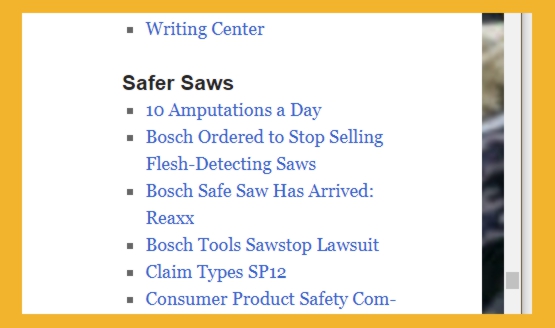
Identify and analyze one claim from each of the eight constituents of this argument. Please remember, claims can be tiny bits of text. An entire paragraph probably contains dozens of claims. If you must quote a paragraph to provide context for the claim you’re analyzing, restrict your evaluation to just one claim within the paragraph.
The constituents:
There are probably other constituents I haven’t listed. If you find one or several, you may substitute it or them for one of these 8.

 | levixvice on Only Abuse |
 | Lunaduna on Only Abuse |
 | cfalover on Counterintuitivity |
 | chickendinner on Card Hypothesis |
 | anonymousgirl116 on 02 Class WED JAN 27 |
 | davidbdale on PTSD Claims-JohnWick66 |
| davidbdale on Causal Rewrite- compIIstudent |
| davidbdale on Rebuttal Rewrite-CompIIstudent |
 612119d
 bluntwriting88
 capched
 cardinal7218
 cfriery
 chavanillo
 Chris McGee
 christianity19
 clementine102
 comicdub
 compiistudent
 corinnebuck1219
 daphneblake25 davidbdale
 dayzur
 g903254
 gabythefujoshi18
 goldin92
 gooferious
 hailthegreat8
 hazelnutlatte123
 honeysucklelilac
 icedcoffeeislife
 imgoingswimming
 iwantpopsicle
 doorknob9
 BabyGoat
 jeffbezos123
 jets1313
 johnwick66
 justheretopass
 kobebryant32
 kowiklinski
 l8tersk8ter
 aquarela
 metro111c
 mrmba1
 mysterylimbo
 nina525
 nousernamefound1
 nyaj32
 oaktree1234
 pardonmyfrench13
 person345
 pomegranate4800
 Jessicariccio
 rosekyd
 rowanrat
 rowanstudent24
 runnerd4
 shadowswife
 SmilingDogTheProfWants
 sonnypetro29
 tcarter101
 thecommoncase
 wafflesrgud22
 wazoo1234
 yourfavoriteanon
